
Supply Chain Traceability for Regenerative Cotton: A Brand Guide
A sourcing manager at a European fashion retailer recently described a situation that will sound familiar to many in the industry. Her brand had committed to sourcing 100% regenerative cotton by 2028. The supplier contracts were signed. The marketing team had already drafted the product page copy. Then the brand's ESG auditor asked a single question: "Can you show us where this cotton was actually grown?"
She could not. Not with any precision. Not with the kind of documented, verifiable evidence that regulators, investors, and increasingly, consumers now expect. What she had was a certificate from a ginning mill and a supplier's word. What she needed was supply chain traceability — a connected, documented record of every step her cotton took from a specific farm in Gujarat or Vidarbha to the finished garment on a retail shelf.
This guide is for textile brands, retailers, and supply chain manufacturers who are ready to close that gap. It covers the practical steps to build end-to-end traceability for regenerative cotton, drawing on real-world experience across India and Bangladesh — and explains how a well-designed traceability system does far more than satisfy an auditor. It becomes a sourcing credibility asset, a carbon accounting foundation, and a tool for building lasting farmer-brand relationships.

Why Traceability Has Become Non-Negotiable for Textile Brands
The regulatory environment has shifted decisively. The EU's Corporate Sustainability Reporting Directive (CSRD) now requires large companies to disclose supply chain sustainability data with the same rigor applied to financial reporting. India's Business Responsibility and Sustainability Reporting (BRSR) framework is tightening requirements for listed companies and their value chains. The EU Green Claims Directive, expected to take full effect in the coming years, will make unsubstantiated sustainability claims a legal liability rather than a marketing risk.
For textile brands, this means that phrases like "sustainably sourced cotton" or "regenerative fiber" can no longer rest on supplier declarations alone. They require documented, traceable evidence. Brands that cannot produce it face regulatory penalties, investor scrutiny, and the reputational damage of greenwashing accusations.
Beyond compliance, there is a commercial logic. Brands that can trace their cotton to specific farms — and demonstrate verified regenerative practices at those farms, are building a sourcing story that commands premium positioning. Retailers like Marks & Spencer, H&M, and Patagonia have demonstrated that verified origin claims translate into consumer trust and margin protection.
There is also the scope 3 emissions dimension. For most fashion brands, 80, 90% of their carbon footprint sits in the supply chain, in the farms, gins, mills, and factories upstream of the brand itself. Accurate scope 3 accounting requires farm-level data. And farm-level data requires traceability. Without it, carbon neutral and net zero commitments remain aspirational rather than verifiable. For a deeper look at how this connects to broader climate targets, see our guide on the Fashion Brand Net Zero Roadmap: 5 Steps to Verified Climate Targets.
1. Map Your Cotton Supply Chain Before You Digitize It
The most common mistake brands make when starting a traceability program is buying software before they understand their supply chain. Technology cannot fix a process that has not been mapped. The first step is always a structured supply chain mapping exercise.
For regenerative cotton sourced from India or Bangladesh, a typical supply chain has six to eight tiers: the farm, the primary buyer or farmer producer organization (FPO), the ginning mill, the spinning mill, the fabric mill or weaver, the cut-and-sew manufacturer, and the brand. Each tier is a potential point of data loss, fiber dilution, or documentation failure.
What a Supply Chain Map Should Capture
- Entity names and locations for every supplier at every tier
- Volume flows, how much cotton moves between each tier and when
- Existing documentation, what records each tier currently produces
- Ownership and contractual relationships, who buys from whom
- Known gaps, tiers where documentation is absent or unreliable
In Beetle Regen's work across cotton-growing regions in India and Bangladesh, supply chain mapping consistently reveals that the biggest traceability gaps sit between the farm and the gin. This is where smallholder cotton from multiple farms is aggregated, often without systematic lot separation. Addressing this gap is the foundation of any credible traceability program.
Once the map is complete, brands can prioritize where to invest in documentation systems, where to require supplier upgrades, and where technology can add the most value. This connects directly to the broader challenge of integrating regenerative agriculture data across supply chains, a process that starts with knowing exactly what data exists and where it lives.
2. Collect Farm-Level Data That Actually Holds Up to Scrutiny
Farm-level data is the foundation of supply chain traceability. Without it, a brand's regenerative claims are built on supplier assurances rather than verified evidence. But collecting reliable data from smallholder farmers across thousands of hectares in rural India or Bangladesh requires a deliberate approach.
What Data to Collect at the Farm Level
- GPS-verified farm boundaries, polygon mapping of each farm plot, not just a village name
- Soil test results, baseline and annual measurements of organic carbon, pH, nitrogen, and microbial activity
- Input records, fertilizer, pesticide, and water use logs that verify regenerative practice adoption
- Seed variety records, cotton variety planted, seed source, and planting date
- Yield data, harvested volume per plot, linked to the farm's GPS boundary
- Practice records, cover crop planting, biochar applications, composting, and other regenerative interventions
Soil testing deserves particular attention. It is both a validation tool for regenerative claims and a carbon accounting input. Brands that require annual soil organic carbon measurements from their supplier farms are building the evidentiary base for verified carbon insetting, not just a sustainability story. For more on how soil testing functions as a brand validation mechanism, see our post on how regenerative farming reverses soil degradation.
Data Collection in Low-Connectivity Environments
Most cotton-growing regions in India, Vidarbha, Telangana, Gujarat, and in Bangladesh have limited or intermittent mobile connectivity. Effective farm-level data collection in these contexts requires mobile tools that work offline and sync when connectivity is available. It also requires farmer onboarding programs that build digital literacy alongside regenerative practice training.
Beetle Regen's field programs combine agronomist-led farm visits with mobile data collection, ensuring that GPS coordinates, soil samples, and practice records are captured systematically rather than relying on farmer self-reporting alone. This approach produces data that holds up to third-party verification, which is what regulators and carbon standard bodies require.
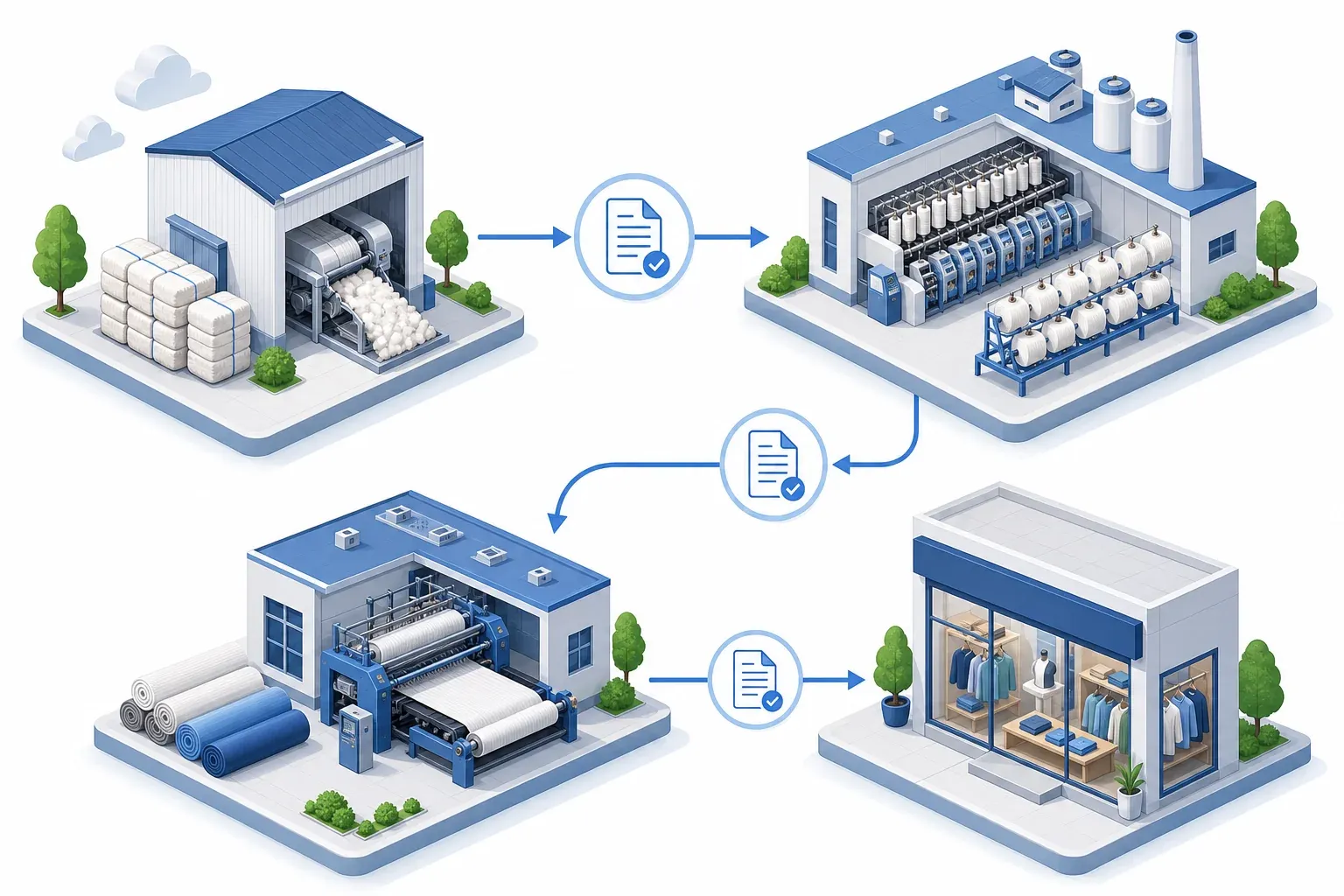
3. Build Chain-of-Custody Documentation Across Every Tier
Farm-level data is necessary but not sufficient. A traceability system must also document the physical movement of cotton through every tier of the supply chain. This is what chain-of-custody (CoC) documentation achieves, and it is where many programs fall short.
Gin-Level Documentation
The ginning stage is the first major aggregation point. Seed cotton from multiple farms arrives at the gin, is cleaned, and emerges as lint cotton in bales. Without systematic lot separation and bale-level documentation, the identity of farm-origin cotton is lost at this stage.
Effective gin-level documentation includes:
- Intake records linking each delivery to a specific farm or FPO, with weight and date
- Bale IDs that carry forward the farm-origin information
- Volume reconciliation, confirming that the volume of regenerative cotton ginned matches the volume of certified bales produced
- Moisture and quality records that support downstream processing documentation
Spinner and Mill Documentation
At the spinning stage, cotton from multiple bales is blended into yarn. This is the point where regenerative fiber can be diluted with conventional cotton if controls are not in place. Brands must require spinners to maintain lot-level traceability, with clear records of which bales entered which yarn lots.
This requires spinners to operate dedicated production runs for regenerative cotton, or to implement mass balance accounting that tracks the percentage of certified fiber in each lot. The same principle applies at the fabric mill and cut-and-sew stages.
Aligning these requirements with established frameworks, such as the Textile Exchange's Organic Content Standard (OCS) or the Global Organic Textile Standard (GOTS) chain-of-custody requirements, gives brands a recognized framework to reference in supplier contracts and audit processes. For a broader view of how compliance frameworks apply to Indian supply chains, see our guide to supply chain transformation through regenerative agriculture consulting.
4. Choose the Right Digital Tools for End-to-End Visibility
Once the supply chain is mapped and documentation requirements are defined, technology can be deployed to connect the data. The market for traceability technology has matured significantly, and brands now have a range of options, each with different strengths and limitations.
Blockchain Traceability: What It Delivers and What It Cannot
Blockchain traceability has attracted significant attention in the textile industry. The core value proposition is immutability, once data is recorded on a blockchain, it cannot be altered without detection. This makes blockchain useful for creating a tamper-evident audit trail of supply chain transactions.
However, blockchain does not solve the fundamental challenge of data quality at the point of entry. If a supplier records inaccurate information, whether through error or intent, that inaccurate information is immutably recorded. Blockchain guarantees the integrity of the record, not the accuracy of the underlying data. This is why farm-level data collection protocols and third-party verification remain essential, regardless of the technology layer used.
QR-Based Platforms and ERP Integration
For many brands, a QR-based traceability platform integrated with existing ERP systems offers a more practical starting point than a full blockchain implementation. These platforms assign unique identifiers to cotton lots at the farm or gin level, and track those identifiers through each subsequent processing stage. The data is accessible via QR code scan, enabling both internal audit teams and consumer-facing transparency applications.
ERP integration is a critical consideration for brands with established procurement and inventory systems. A traceability platform that cannot exchange data with the brand's ERP creates manual reconciliation work and increases the risk of data errors. When evaluating traceability tools, brands should prioritize platforms with documented API integration capabilities and experience connecting to common ERP environments. Our detailed guide on API integration for carbon credit platforms covers the technical architecture considerations that apply equally to traceability systems.
Beetle Regen's Traceability Approach
Beetle Regen's Sustainability as a Service (SaaS) model connects farm-level data collection, GPS mapping, soil testing, practice records, to a brand-facing dashboard that provides real-time visibility into the origin and journey of regenerative cotton. This approach is designed specifically for the realities of Indian and Bangladeshi supply chains: smallholder farm structures, variable connectivity, multi-tier aggregation, and the need to connect traceability data to carbon accounting outputs simultaneously.
5. Connect Traceability Data to Carbon Accounting and Insetting
A well-designed traceability system does more than satisfy an auditor. It generates the farm-level data that makes carbon accounting credible and carbon insetting verifiable.
For fashion brands working toward carbon neutral or net zero targets, the supply chain is where the largest emissions reductions are available, and where the largest data gaps currently exist. Scope 3 category 1 (purchased goods and services) covers the emissions embedded in raw material production. For a cotton-intensive brand, this means the emissions from cotton farming: synthetic fertilizer use, irrigation energy, soil carbon loss from tillage, and methane from associated rice cultivation in the same farming regions.
Traceability records, specifically input logs, soil test results, and practice records, provide the activity data needed to calculate these emissions accurately. Without farm-level traceability, brands are forced to use industry-average emission factors, which are both less accurate and less defensible under emerging reporting standards.
Linking Traceability to Carbon Insetting
Carbon insetting goes further. Rather than purchasing carbon credits from unrelated projects to offset supply chain emissions, insetting involves investing in emission reductions and carbon sequestration within the brand's own supply chain. Verified insetting requires the same farm-level data that traceability systems collect: soil organic carbon measurements, biochar application records, cover crop adoption rates, and yield data.
This means that a brand investing in supply chain traceability is simultaneously building the data infrastructure for verified carbon insetting. The two programs reinforce each other, and together, they provide the evidence base for credible sustainability disclosures under CSRD, BRSR, and the Science Based Targets initiative (SBTi). For a comprehensive framework on how carbon sequestration connects to these reporting requirements, see our post on carbon sequestration in agriculture.
6. Use Traceability to Strengthen Farmer-Brand Relationships

Traceability is often discussed as a tool for brands, a way to manage risk, satisfy regulators, and tell a better sustainability story. But in the context of regenerative cotton sourcing from India and Bangladesh, traceability also creates direct value for farmers.
Premium Pricing Through Verified Identity
When a farmer's cotton can be traced to a specific plot with documented regenerative practices, it becomes a differentiated product. Brands willing to pay a premium for verified regenerative fiber need the traceability data to justify that premium to their own procurement and finance teams. Without it, the premium is a goodwill gesture. With it, the premium is a documented sourcing decision with a clear rationale.
This matters enormously for farmer income. Smallholder cotton farmers in India face persistent income pressure from input cost inflation, yield variability, and commodity price volatility. A verified regenerative premium, even a modest one, can meaningfully improve household income and incentivize continued adoption of regenerative practices. Traceability is the mechanism that makes that premium commercially defensible for the brand and financially meaningful for the farmer.
Building Long-Term Sourcing Partnerships
Transactional procurement, buying cotton on the spot market with no ongoing supplier relationship, is incompatible with traceability. Effective traceability requires multi-season data collection, supplier investment in documentation systems, and the kind of trust that only develops through sustained engagement.
Brands that commit to multi-year sourcing agreements with regenerative cotton programs are not just securing supply. They are building the relational infrastructure that makes traceability data reliable. Farmers who trust that their data will be used to reward them, rather than to audit them out of the program, are more likely to provide accurate records and adopt the practices that generate the data in the first place.
Beetle Regen's farmer-first approach to program design reflects this principle. Capacity building, agronomist support, and transparent data sharing are built into the program structure, not added as afterthoughts. This is what makes the traceability data generated through these programs credible: it comes from farmers who understand why the data matters and how it benefits them.
7. Turn Traceability Into a Sourcing Credibility Asset

The final step in building a traceability program is converting the data into a sourcing credibility asset, something that actively supports the brand's commercial and sustainability objectives, not just its compliance obligations.
ESG Reporting and Regulatory Disclosure
Traceability data feeds directly into the supply chain disclosures required under CSRD, BRSR, and the EU's upcoming supply chain due diligence regulations. Brands with documented, farm-level traceability are in a fundamentally stronger position than those relying on supplier declarations. They can answer specific questions, "What percentage of your cotton comes from farms with verified soil health improvements?", with data rather than estimates.
This matters not just for regulatory compliance but for investor relations. ESG-focused investors are increasingly sophisticated in their assessment of supply chain sustainability claims. A brand that can produce a traceability report showing GPS-verified farm origins, soil carbon trend data, and chain-of-custody documentation across all processing tiers is demonstrating a level of supply chain governance that commands investor confidence. For a practical framework on translating this kind of data into board-ready metrics, see our guide on the Modern ESG Dictionary.
Consumer-Facing Transparency
QR codes on product labels that link to farm origin stories, soil health data, and farmer profiles are becoming a meaningful differentiator in premium retail. Consumers who scan a QR code and see a named farm in Vidarbha, a soil carbon improvement chart, and a farmer's story are experiencing something qualitatively different from a generic "sustainably sourced" label claim.
This kind of consumer-facing transparency requires the same underlying data infrastructure as regulatory compliance, which means that a well-designed traceability system serves both purposes simultaneously. The investment in farm-level data collection and chain-of-custody documentation pays dividends across the brand's entire sustainability communications strategy.
Connecting Traceability to Net Zero Commitments
For brands with published net zero targets, supply chain traceability is not a separate workstream, it is the data foundation that makes those targets credible. Without traceable, farm-level data, scope 3 emissions calculations are estimates. Carbon insetting claims are unverifiable. Regenerative sourcing commitments are marketing language.
With traceability, all of these become documented, auditable, and defensible. That is the commercial case for investing in traceability now, before regulatory requirements make it mandatory and before competitors establish the credibility advantage that early movers will hold.
"Traceability is not the end goal, it is the infrastructure that makes every other sustainability commitment credible. Brands that build it now are building a competitive moat, not just a compliance file."
Frequently Asked Questions
How long does it take to implement a traceability system for regenerative cotton?
A basic traceability system, covering farm registration, GPS mapping, and gin-level documentation, can be operational within one growing season (approximately 6, 9 months for Indian cotton). Full end-to-end traceability, including spinner and mill documentation and ERP integration, typically requires 12, 18 months to implement robustly. The timeline depends heavily on the number of supply chain tiers involved and the existing documentation maturity of suppliers.
Can traceability work for smallholder farmers in India and Bangladesh?
Yes, but it requires a program design that accounts for smallholder realities: low digital literacy, limited connectivity, small plot sizes, and aggregation through intermediaries. Effective smallholder traceability relies on field-based data collection by trained agronomists, mobile tools that work offline, and farmer producer organizations (FPOs) that can aggregate data at the village level. Beetle Regen's programs are specifically designed for this context.
What is the difference between supply chain transparency and traceability?
Transparency refers to disclosing information about the supply chain, publishing a supplier list, for example. Traceability is the ability to track a specific product or material through each step of the supply chain, with documented evidence at each handoff. Transparency is a disclosure practice; traceability is a data and documentation system. Traceability enables transparency, but transparency does not require traceability.
Does blockchain traceability guarantee authenticity?
No. Blockchain guarantees that recorded data has not been altered after entry, it does not verify that the data was accurate when it was entered. Authenticity requires rigorous data collection protocols, third-party verification, and physical inspection at key supply chain nodes. Blockchain is a useful tool for creating a tamper-evident audit trail, but it is not a substitute for the human and institutional processes that ensure data quality at the source.
How does traceability support carbon insetting verification?
Carbon insetting requires evidence that specific emission reductions or carbon sequestration events occurred within the brand's supply chain. Traceability systems collect the farm-level data, soil carbon measurements, input records, practice adoption logs, that carbon standard bodies require to verify insetting claims. Without traceability, insetting claims cannot be independently verified and are vulnerable to challenge under emerging sustainability reporting standards.
Build Your Traceability Program With Beetle Regen
Implementing supply chain traceability for regenerative cotton is a multi-season commitment that requires expertise across agronomy, data systems, supply chain management, and sustainability reporting. It is also one of the highest-leverage investments a textile brand can make in 2026, building the data foundation for verified carbon accounting, credible ESG disclosures, and premium sourcing differentiation that competitors without traceability simply cannot match.
Beetle Regen works with textile brands, retailers, and supply chain manufacturers across India and Bangladesh to design and implement traceability programs that are built for the realities of smallholder supply chains, not just for the requirements of a certification checklist. From farm-level GPS mapping and soil testing to chain-of-custody documentation and brand-facing dashboards, our Sustainability as a Service model connects every step of the journey.
If you are ready to move from sustainability claims to verified supply chain evidence, connect with the Beetle Regen team to discuss how a traceability program can be designed for your specific sourcing context and reporting requirements.