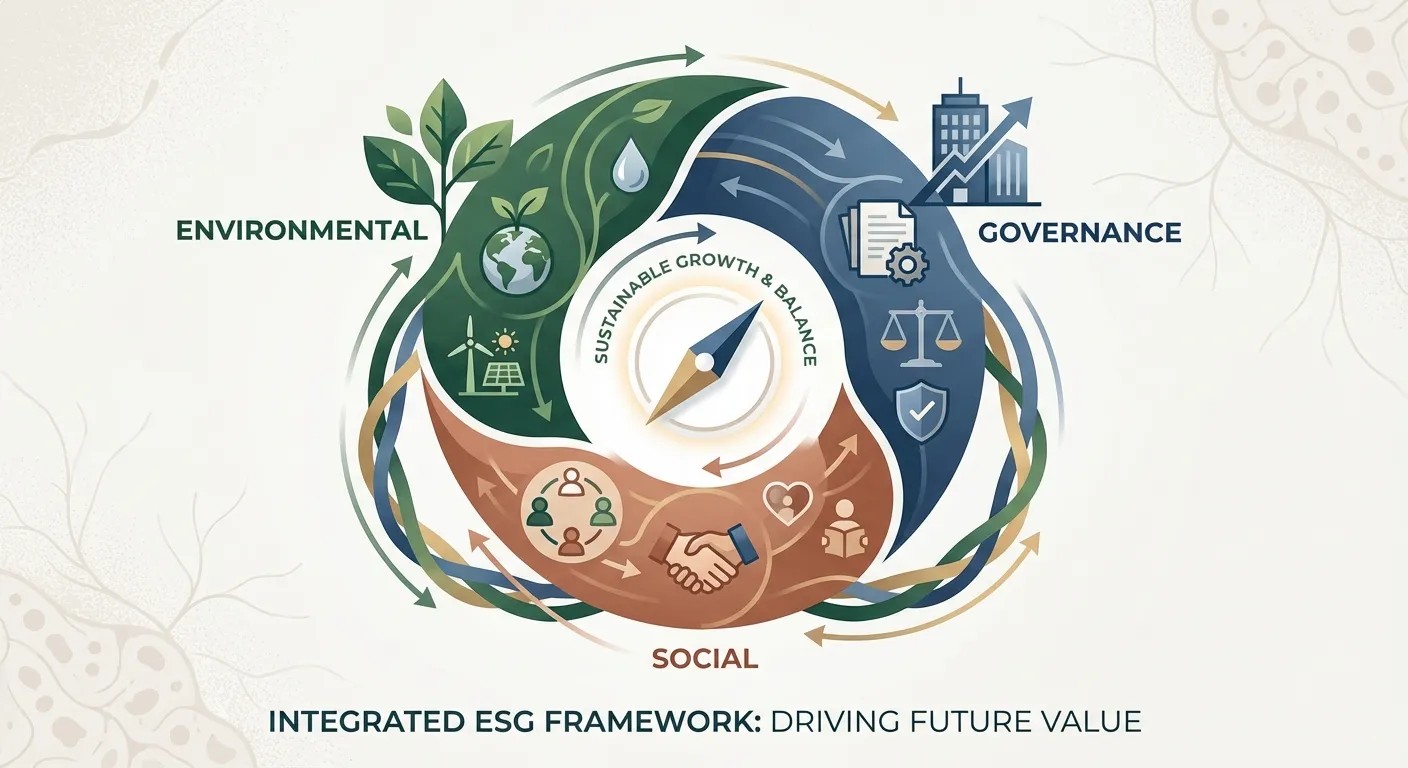
The Modern ESG Dictionary: All You Need to Know
The language of sustainability has exploded in recent years. Terms like ESG, regenerative agriculture, carbon sequestration, and circular economy have moved from niche environmental circles into boardrooms, supply chain meetings, and investor presentations. For brands, manufacturers, and sustainability professionals working in textiles, agriculture, and supply chains, understanding this evolving vocabulary isn't just about keeping up with trends—it's about making informed decisions that drive real environmental and business impact.
This modern ESG dictionary cuts through the jargon to explain what these terms really mean in today's business context. Whether you're a sustainability leader navigating Net Zero commitments, a supply chain professional implementing traceability systems, or a manufacturer exploring regenerative sourcing, this comprehensive guide provides the clarity you need to move from terminology to transformation.
Core ESG Concepts: The Foundation
Before diving into specialized terminology, it's essential to understand the foundation. ESG stands for Environmental, Social, and Governance—three pillars that represent how organizations manage their impact on the planet, people, and ethical business practices. Unlike traditional corporate social responsibility (CSR), which often focused on philanthropy and community programs, ESG integrates sustainability into core business strategy and operations.
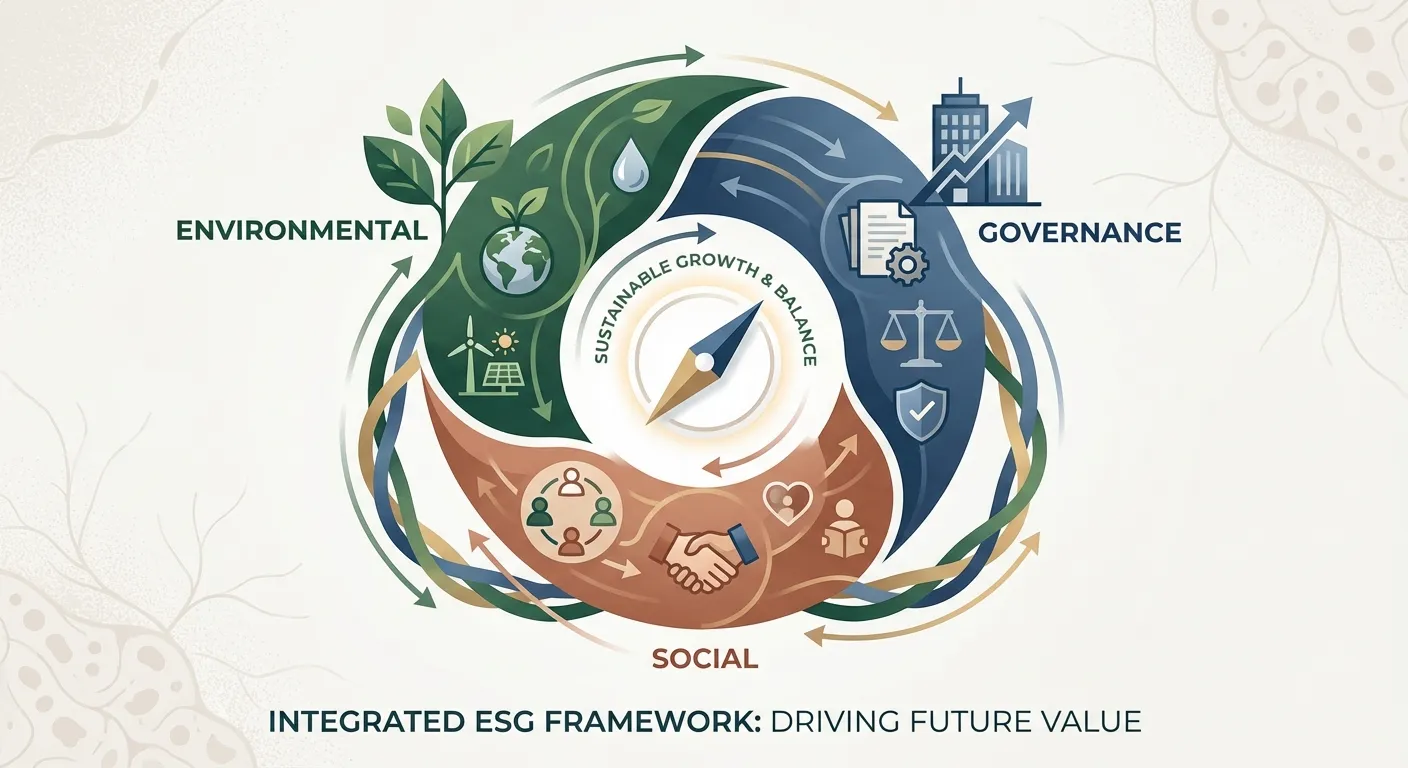
The evolution from CSR to ESG reflects a fundamental shift in how businesses approach sustainability. ESG is measurable, reportable, and increasingly tied to financial performance. For textile and agriculture industries, this means moving beyond compliance to create competitive advantage through sustainable practices.
Stakeholder engagement sits at the heart of effective ESG implementation. This term refers to the systematic process of involving everyone affected by business decisions, from farmers and factory workers to investors and local communities. In the context of regenerative agriculture and textile supply chains, stakeholder engagement means creating collaborative platforms where knowledge flows in multiple directions, not just top-down mandates.
The business case for ESG integration is compelling. Companies with strong ESG performance typically experience better risk management, improved operational efficiency, enhanced brand reputation, and increased access to capital. For agricultural businesses and textile manufacturers, ESG integration often translates directly into soil health improvements, reduced input costs, and premium market access.
Environmental Terms in the Modern ESG Dictionary
Carbon sequestration is the process of capturing and storing atmospheric carbon dioxide in soil, plants, or geological formations. In agricultural contexts, this happens when plants absorb CO2 through photosynthesis and transfer carbon into the soil through root systems and organic matter decomposition. Regenerative farming practices can significantly enhance this natural process, turning agricultural land into carbon sinks rather than carbon sources.
Understanding the difference between Net Zero and carbon neutral is critical for setting meaningful climate goals. Carbon neutral means balancing emissions by purchasing offsets or credits to compensate for the carbon you produce. Net Zero is more ambitious, it requires reducing emissions as close to zero as possible across your entire value chain (Scope 1, 2, and 3), with only residual emissions offset. For textile companies, achieving Net Zero means transforming everything from raw material sourcing to manufacturing processes and transportation.
Soil health refers to the continued capacity of soil to function as a vital living ecosystem that sustains plants, animals, and humans. Healthy soil contains diverse microbial communities, adequate organic matter, proper structure for water infiltration, and balanced nutrients. Conversely, soil degradation describes the decline in soil quality caused by improper use, typically from conventional farming practices that deplete organic matter, compact soil structure, and reduce biodiversity. According to the UN FAO, 33% of global soils are already degraded, a crisis that demands urgent attention.
The circular economy represents a systemic shift from the traditional linear "take-make-dispose" model to one where resources are kept in use for as long as possible. In textiles, this means designing products for durability and recyclability, implementing take-back programs, and creating closed-loop systems where waste becomes input for new production. Circular economy principles challenge the fast-fashion model and require rethinking entire supply chains.
Traceability and transparency have become non-negotiable in modern supply chains. Traceability refers to the ability to track a product's journey from origin to consumer, documenting every step and transformation. Transparency means openly sharing this information with stakeholders. For textile companies sourcing cotton, traceability might mean knowing exactly which farms grew the fiber, what practices were used, and how it moved through ginning, spinning, weaving, and finishing. Data integration systems make this level of visibility possible.
Regenerative Agriculture: Beyond Sustainability
Regenerative agriculture goes beyond sustaining current conditions to actively improving and restoring ecosystem health. While sustainable farming aims to maintain resources without depletion, regenerative agriculture seeks to enhance soil fertility, increase biodiversity, improve water cycles, and sequester carbon, leaving the land better than it was found.
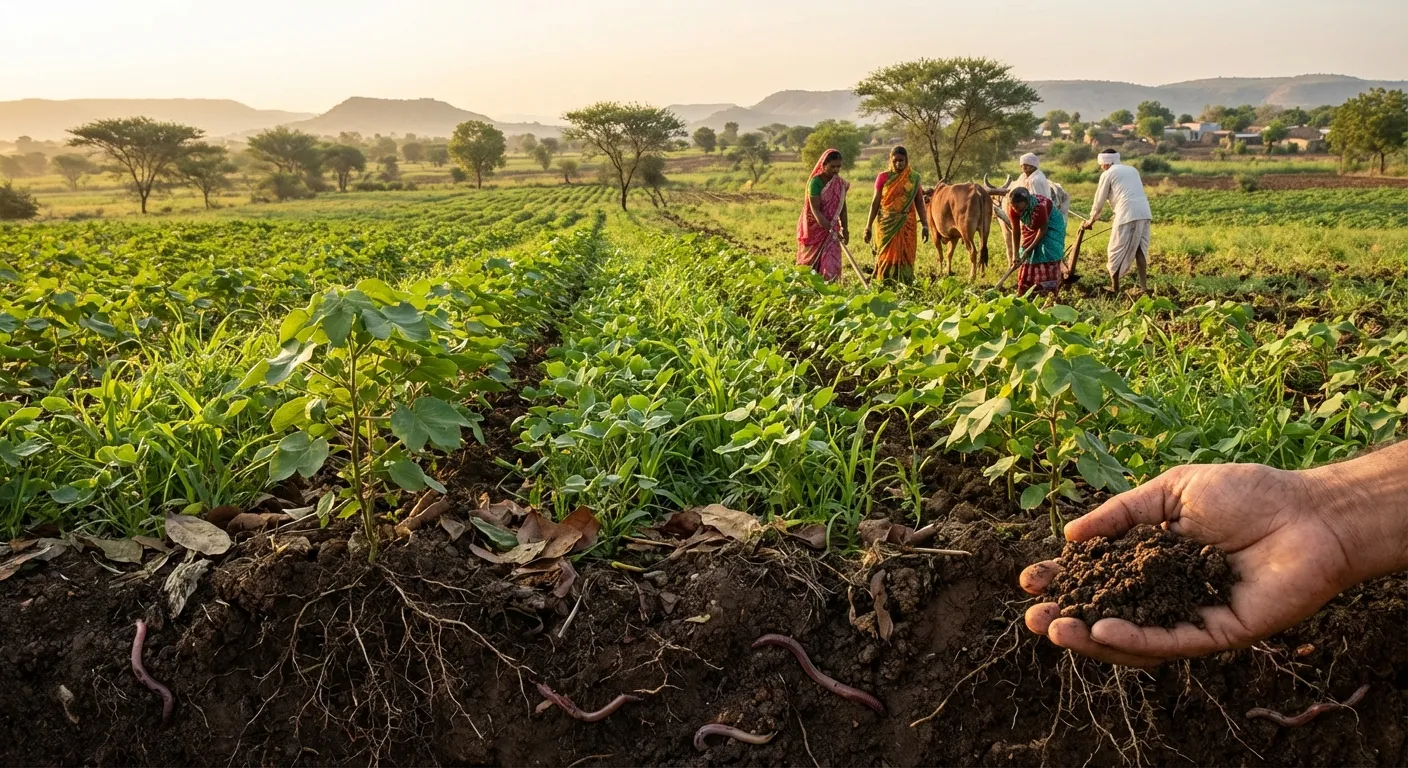
The distinction between regenerative, conventional, and organic farming is important. Conventional agriculture typically relies on synthetic inputs, monocultures, and tillage practices that can degrade soil over time. Organic farming eliminates synthetic chemicals but doesn't necessarily rebuild soil health. Regenerative agriculture focuses on outcomes, measurable improvements in soil organic matter, water retention, biodiversity, and carbon sequestration, regardless of whether some approved inputs are used.
Key regenerative agriculture practices include minimal or no tillage, diverse crop rotations and cover cropping, integrated livestock management, and composting. These practices work together to build soil organic matter, which is the foundation of both soil health and carbon sequestration. When implemented effectively, regenerative methods can sequester 0.5 to 2 tons of carbon per hectare annually while simultaneously improving crop yield and resilience.
Farmer training and capacity building are essential components of successful regenerative transitions. These terms refer to collaborative knowledge-building programs that equip farmers with the understanding, skills, and confidence to implement new practices. Effective capacity building isn't about imposing external solutions, it's about co-creating approaches that work within local contexts, combining traditional knowledge with scientific innovation.
The economic benefits of regenerative agriculture extend throughout the supply chain. Farmers experience reduced input costs, improved yields over time, and access to premium markets. Manufacturers gain supply chain resilience and differentiated products. Retailers and brands strengthen their sustainability credentials and meet consumer demand for responsible sourcing. This creates a compelling business case that goes far beyond environmental benefits alone.
Textile and Fashion Industry ESG Terms
Textile sustainability encompasses the environmental, social, and economic impacts of fiber production, fabric manufacturing, garment construction, distribution, use, and end-of-life management. The textile industry is resource-intensive, consuming vast amounts of water, energy, and chemicals while generating significant waste and emissions. Textile sustainability seeks to minimize these impacts through better materials, cleaner processes, and circular systems.
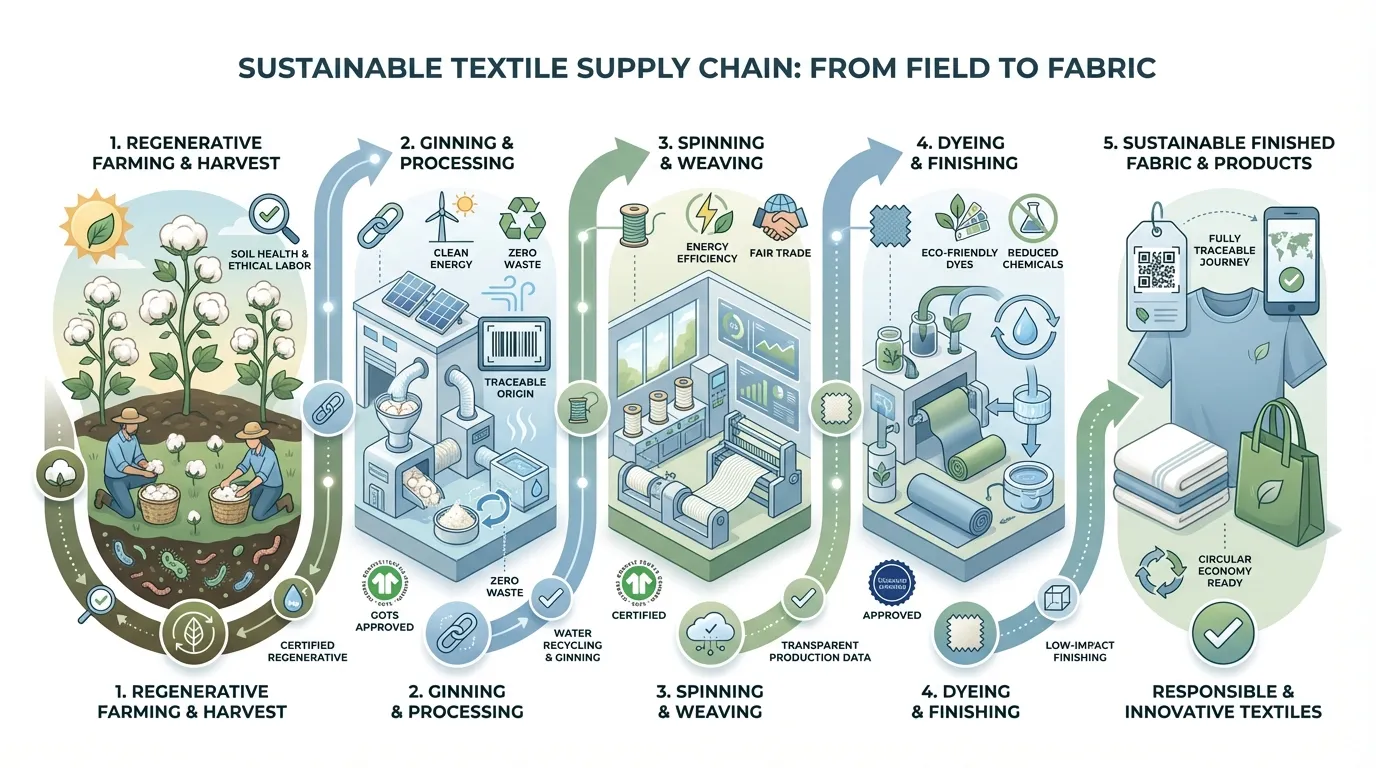
Responsible sourcing means procuring raw materials and services in a way that respects people and planet. For textile companies, this includes ensuring fair labor practices, environmental stewardship, and traceability throughout the supply chain. Responsible sourcing requires knowing not just your direct suppliers, but also the farms, communities, and ecosystems at the very beginning of your value chain.
Natural fibres like cotton, wool, linen, and hemp offer renewable alternatives to synthetic materials derived from fossil fuels. However, not all natural fibres are created equal. Conventionally grown cotton, for example, is highly water and pesticide-intensive. Regenerative cotton represents a new category, cotton grown using regenerative agriculture principles that actively improve soil health, sequester carbon, and support farmer livelihoods. This creates a premium product with verified environmental benefits.
Organic certification verifies that crops were grown without synthetic pesticides, fertilizers, or GMOs, following specific standards like GOTS (Global Organic Textile Standard). While valuable, organic certification focuses primarily on what isn't used rather than positive outcomes. Regenerative certification, an emerging category, measures actual improvements in soil health, biodiversity, and carbon sequestration. Some farms pursue both certifications to meet different market requirements.
Circular textile innovation refers to new technologies, business models, and design approaches that enable circularity. This includes fiber-to-fiber recycling technologies, rental and resale platforms, modular design for easy repair, and bio-based materials that safely biodegrade. These innovations challenge the linear model that has dominated fashion for decades and create new value from what was previously considered waste.
Agriculture and Soil-Focused Terminology
Understanding soil health requires familiarity with key indicators. Soil organic matter (SOM) is the fraction of soil composed of decomposed plant and animal material. It's the single most important indicator of soil health, affecting water retention, nutrient availability, carbon storage, and microbial activity. Increasing SOM from 1% to 3% can dramatically improve a soil's capacity to support crops and sequester carbon.
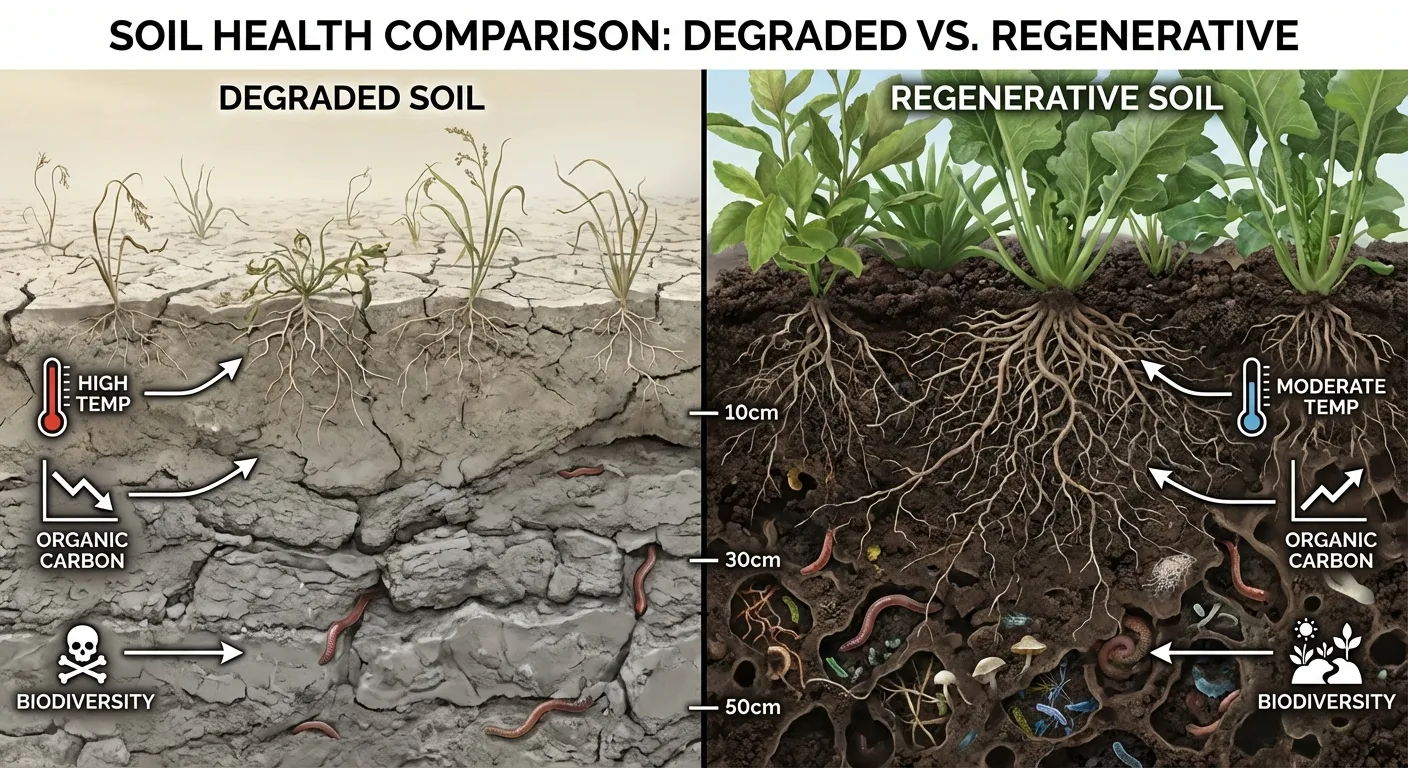
Soil structure refers to how soil particles aggregate together. Good structure creates pore spaces that allow water infiltration, air circulation, and root penetration. Poor structure, often caused by compaction from heavy machinery or loss of organic matter, creates hard, impenetrable layers that limit plant growth and increase erosion.
Sustainable farming practices is a broad term covering techniques that maintain productivity while minimizing environmental harm. This includes integrated pest management (using biological controls before chemical interventions), precision agriculture (applying inputs only where and when needed), water conservation techniques, and agroforestry (integrating trees into farming systems). The goal is to meet current needs without compromising future generations' ability to do the same.
Crop yield optimization through regenerative methods challenges the conventional wisdom that high yields require high chemical inputs. Research increasingly shows that healthy soils with diverse microbial communities, adequate organic matter, and good structure can produce yields equal to or exceeding conventional systems, especially during drought or extreme weather. The key is building soil biology that makes nutrients available to plants naturally.
Nature-based solutions are actions that protect, sustainably manage, or restore natural ecosystems while addressing societal challenges like climate change, food security, and water availability. In agriculture, this includes practices like riparian buffer zones, hedgerows for beneficial insects, wetland restoration, and agroforestry. These solutions provide multiple benefits simultaneously, carbon sequestration, biodiversity habitat, water filtration, and often improved farm productivity.
Climate Action and Carbon Terms
Understanding your carbon footprint, the total greenhouse gas emissions caused by an organization, product, or activity, is the starting point for climate action. Less commonly discussed is the carbon handprint, which measures the positive climate impact of your products or services. For companies providing regenerative agriculture solutions, the carbon handprint includes the emissions avoided and carbon sequestered through the practices they enable.
Scope 1, 2, and 3 emissions represent different categories in greenhouse gas accounting. Scope 1 covers direct emissions from owned or controlled sources (like company vehicles or on-site fuel combustion). Scope 2 includes indirect emissions from purchased electricity, steam, heating, and cooling. Scope 3 encompasses all other indirect emissions in the value chain, both upstream (purchased goods, transportation) and downstream (product use, end-of-life). For most companies, Scope 3 represents 70-90% of total emissions and is the hardest to measure and reduce.
Carbon credits represent one metric ton of CO2 equivalent that has been avoided or removed from the atmosphere. These credits can be generated through verified projects like reforestation, renewable energy, or regenerative agriculture, then sold to organizations seeking to offset their emissions. The quality and integrity of carbon credits varies significantly based on additionality (would the project have happened anyway?), permanence (how long is carbon stored?), and verification standards.
The distinction between climate-positive and climate-neutral matters. Climate-neutral means achieving net-zero emissions through reduction and offsetting. Climate-positive (also called carbon-negative) means removing more carbon from the atmosphere than you emit, creating a net positive impact. This is achievable through regenerative agriculture at scale, where carbon sequestration exceeds all operational emissions.
Science-Based Targets (SBTi) provide a framework for companies to set emissions reduction goals aligned with climate science, specifically, limiting global warming to 1.5°C above pre-industrial levels. SBTi-approved targets require absolute emissions reductions across Scope 1, 2, and 3, with specific timelines and methodologies. This framework has become the gold standard for corporate climate commitments, moving beyond vague "carbon neutral" pledges to measurable, accountable action.
Social and Governance Dimensions
While environmental terms often dominate ESG discussions, the social and governance dimensions are equally critical. Stakeholder engagement in practice means creating mechanisms for two-way dialogue with everyone affected by your operations. This includes farmer advisory boards, worker committees, community consultations, and transparent reporting. Effective engagement influences decision-making, not just communicates decisions already made.
Fair trade and farmer livelihoods address the economic justice dimension of sustainability. Fair trade certification ensures farmers receive minimum prices that cover production costs plus a premium for community development. Beyond certification, supporting farmer livelihoods means providing access to training, financing, markets, and risk-sharing mechanisms that enable economic resilience. When farmers thrive economically, they can invest in long-term soil health and environmental stewardship.
Community regeneration extends regenerative principles beyond soil to social systems. Just as regenerative agriculture restores ecosystem health, community regeneration rebuilds social capital, local economies, and cultural vitality. This might include reviving traditional knowledge, creating local processing facilities that add value before export, or developing cooperative structures that give farmers collective bargaining power.
Transparency and accountability are governance principles that build trust. Transparency means openly sharing information about practices, impacts, and progress, including challenges and setbacks. Accountability means establishing clear responsibilities, measuring performance against commitments, and accepting consequences when targets aren't met. Together, these principles prevent greenwashing and ensure ESG commitments translate into real action.
Collaborative approaches recognize that no single organization can solve complex sustainability challenges alone. This includes multi-stakeholder initiatives, industry coalitions, public-private partnerships, and farmer cooperatives. Collaborative platforms enable knowledge sharing, resource pooling, and collective problem-solving that accelerates progress beyond what any individual actor could achieve.
Putting the Modern ESG Dictionary into Practice
Understanding ESG terminology is valuable only when it leads to action. The first step is conducting a baseline assessment using data-led, evidence-based approaches. This means measuring current performance across environmental, social, and governance dimensions using standardized metrics. For agricultural supply chains, this includes soil health assessments, carbon footprint calculations, water use audits, and social impact evaluations.
Building collaborative programs across supply chains requires moving beyond transactional relationships to genuine partnerships. This means co-designing solutions with farmers, sharing risks and rewards, and investing in long-term capacity building rather than demanding immediate compliance with new standards. Organizations like Beetle Regen Solutions demonstrate this approach through collaborative knowledge-building programs that train farmers while creating economic benefits throughout the value chain.
Effective measurement and reporting makes ESG progress visible and credible. This includes selecting appropriate frameworks (like GRI, SASB, or TCFD), establishing key performance indicators, implementing data collection systems, and publishing regular progress reports. For regenerative agriculture programs, measurement should track both environmental outcomes (soil organic matter, carbon sequestered, biodiversity) and social impacts (farmer income, community wellbeing, knowledge transfer).
The ultimate goal is moving from terminology to transformation, using this modern ESG dictionary not just to speak the language of sustainability, but to drive fundamental changes in how business operates. This requires leadership commitment, cross-functional collaboration, stakeholder engagement, and patience for long-term results. Regenerative approaches don't deliver overnight transformations, but they create compounding benefits that strengthen over time.
For textile manufacturers, this might mean transitioning to regenerative cotton sourcing while building traceability systems that verify environmental claims. For agricultural businesses, it could involve implementing regenerative practices on owned or contracted farmland while participating in carbon credit programs. For corporate sustainability teams, it means setting science-based targets and investing in nature-based solutions throughout the value chain.
Conclusion: From Language to Leadership
This modern ESG dictionary provides the foundation for informed decision-making in an increasingly complex sustainability landscape. Understanding terms like carbon sequestration, regenerative agriculture, circular economy, and stakeholder engagement enables more strategic conversations, better vendor selection, and more credible sustainability commitments.
However, true leadership requires moving beyond vocabulary to action. The textile and agriculture industries face urgent environmental challenges, from soil degradation affecting 33% of global soils to the climate crisis demanding rapid decarbonization. These challenges also present opportunities for companies willing to embrace regenerative approaches that restore ecosystems while building resilient, profitable businesses.
The language of ESG will continue evolving as our understanding deepens and new solutions emerge. What matters most is not mastering every term in this modern ESG dictionary, but using this knowledge to drive meaningful change. Whether you're implementing your first regenerative agriculture pilot, building supply chain traceability systems, or setting Net Zero targets, the journey begins with understanding and commitment.
Organizations working at the intersection of agriculture, textiles, and sustainability need partners who combine deep expertise with collaborative approaches. Beetle Regen Solutions provides regenerative agriculture consulting, farmer training programs, and implementation services that help businesses transition to sustainable practices while achieving carbon neutral and Net Zero goals. If you're ready to move from ESG terminology to transformation, contact us to explore how regenerative agriculture can strengthen your supply chain, reduce environmental impact, and create shared value from farm to consumer.
The modern ESG dictionary is your starting point. The real work, and the real opportunity, lies in putting these concepts into practice across your operations and supply chains. Start today, and be part of the regenerative movement reshaping agriculture, textiles, and climate action for 2026 and beyond.