
The Complete Buyer's Guide to Sustainable Sourcing for Textile Brands in 2026
Sustainable sourcing has moved from a brand differentiator to a business imperative. In 2026, textile brands and retailers face a convergence of regulatory mandates, investor scrutiny, and consumer expectations that make the question no longer whether to source sustainably, but how to do it credibly, traceably, and at scale. This guide is built for procurement teams, sustainability leads, and supply chain managers who need a practical framework to evaluate suppliers, verify claims, compare pricing models, and select the right partner to meet their carbon neutral and ESG commitments.

Why Sustainable Sourcing Is No Longer Optional for Textile Brands
The regulatory landscape has shifted decisively. The EU Corporate Sustainability Reporting Directive (CSRD) now requires large companies to disclose detailed sustainability data, including scope 3 emissions from their supply chains. India's Bureau of Indian Standards (BIS) is tightening textile compliance requirements, and major markets in Europe and North America are introducing import regulations tied to environmental and labor standards. For textile brands sourcing from India and Bangladesh, this means that sustainable sourcing is now a compliance requirement, not just a values statement.
Investor pressure is equally significant. ESG ratings agencies are scrutinizing supply chain practices with greater rigor. Brands that cannot demonstrate credible, traceable sustainable sourcing programs face higher cost of capital, exclusion from ESG-focused funds, and reputational exposure. According to the Textile Exchange's 2025 Materials Benchmark, brands with verified sustainable fiber programs consistently outperform peers on ESG scores and long-term investor confidence.
The cost of inaction is real. Supply chains built on conventional cotton face growing risks: soil degradation (the UN FAO estimates that 33% of global soils are already degraded), water scarcity, and climate-driven yield volatility. Brands that delay their transition to sustainable sourcing are not just missing an opportunity. They are accumulating risk. Those that move early gain supply security, stronger supplier relationships, and a credible sustainability narrative that resonates with retailers, consumers, and regulators alike.
To understand how regenerative agriculture aligns with the broader policy environment shaping these requirements, see our post on How Regenerative Agriculture Aligns with Climate Policy.
Understanding Regenerative Fiber: What Sustainable Sourcing Really Means in 2026
Not all sustainable sourcing is equal. The market is crowded with labels — organic, Better Cotton, recycled, bio-based — and procurement teams need clarity on what each actually delivers. In 2026, the most credible and impactful tier of sustainable sourcing is regenerative fiber, and understanding what sets it apart is the foundation of any serious evaluation process.
Organic vs. Conventional vs. Regenerative Cotton
Organic cotton avoids synthetic pesticides and fertilizers, which is meaningful. But it does not require active soil restoration, carbon sequestration, or measurable ecosystem improvement. Conventional cotton is resource-intensive, relying heavily on synthetic inputs that degrade soil health over time. Regenerative cotton goes further than both. It actively rebuilds soil organic matter, sequesters carbon, restores biodiversity, and improves water retention. The result is a fiber that is not just less harmful but genuinely restorative.
Key Regenerative Practices That Define Credible Sustainable Sourcing
- Soil testing and monitoring: Baseline and ongoing soil health assessments that track organic carbon, microbial activity, and nutrient levels.
- Biochar applications: Incorporating biochar into soil to sequester carbon long-term and improve soil structure and water retention.
- Cover crops: Planting cover crops between cotton seasons to prevent erosion, fix nitrogen, and build organic matter. Learn more in our guide on Cover Crops in Regenerative Agriculture.
- Alternative Wetting and Drying (AWD): A water management technique used in paddy farming that significantly reduces methane reduction emissions from flooded fields.
- High-Density Planting System (HDPS): Optimizing plant spacing to improve yields without expanding land use.
- Reduced or eliminated synthetic inputs: Transitioning farmers away from chemical dependency toward biological and natural alternatives.
Farmer Income as a Core Pillar
Genuine sustainable sourcing cannot be separated from farmer welfare. Programs that squeeze farmer margins to deliver cheap fiber are not sustainable in any meaningful sense. The best sourcing partners build programs where farmer income improves alongside environmental outcomes. This means fair price premiums, capacity building, access to inputs, and in some cases, carbon credit revenue that provides an additional income stream for farming communities.
For a deeper look at how regenerative practices affect crop yields and farmer economics, see How Regenerative Agriculture Increases Crop Yield.
How to Evaluate Regenerative Fiber Suppliers: A Procurement Checklist
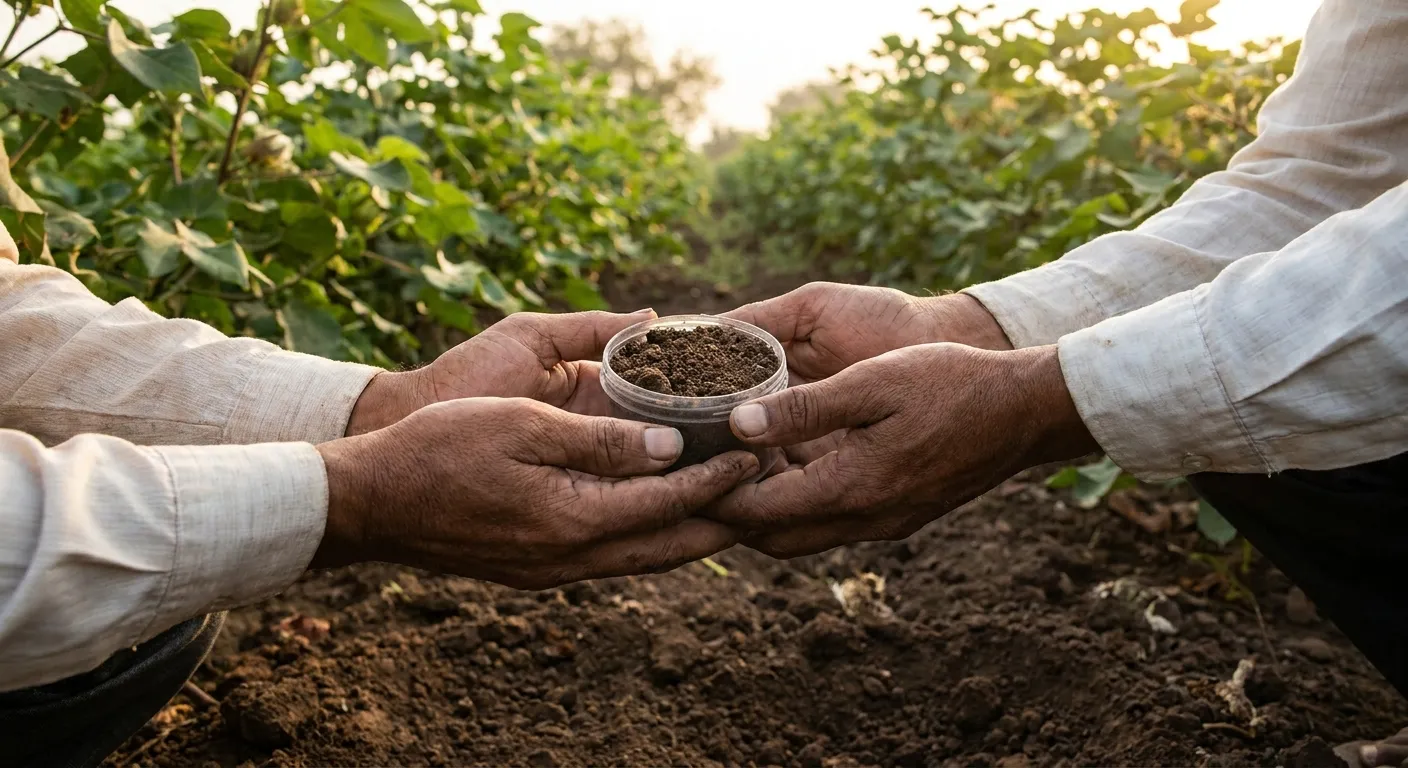
Evaluating a sustainable sourcing partner requires going beyond marketing materials and certification logos. Here is a structured checklist for procurement teams conducting supplier due diligence.
1. Soil Health Infrastructure
- Does the supplier conduct baseline soil testing before enrolling farmers?
- Are soil health metrics tracked seasonally and reported transparently?
- What parameters are measured: organic carbon, pH, microbial biomass, bulk density?
- Is there a third-party laboratory involved in soil analysis?
2. Farmer Training and Capacity Building
- What structured training programs are in place for farmers transitioning to regenerative practices?
- How many farmers are currently enrolled, and what is the retention rate across seasons?
- Is training delivered in local languages with on-the-ground agronomists?
- Are farmer income outcomes tracked and reported?
3. Carbon Sequestration Methodology
- What carbon accounting methodology does the supplier use (e.g., Verra, Gold Standard, proprietary)?
- Are carbon sequestration claims verified by an independent third party?
- Does the supplier offer carbon insetting (sequestration within your own supply chain) as distinct from offsetting?
- How are biochar applications quantified and reported?
4. Traceability and Technology Infrastructure
- Does the supplier offer blockchain traceability from farm to mill?
- What data is captured at each node of the supply chain?
- Is the traceability system compatible with your existing ERP integration or sustainability reporting platforms?
- Can the supplier provide transaction certificates and chain-of-custody documentation?
5. Certifications and Standards Alignment
- Which third-party standards does the supplier align with (Textile Exchange, GOTS, Regenerative Organic Certified, etc.)?
- Are certifications current and independently audited?
- Does the supplier participate in industry initiatives like the Organic Cotton Accelerator or Cotton Connect?
For a comprehensive look at how data flows across regenerative supply chains, see our post on How to Integrate Regenerative Agriculture Data Across Supply Chains.
Verifying Sustainability Claims: How to Spot Greenwashing vs. Genuine Impact

Greenwashing remains one of the biggest risks in sustainable sourcing. As regulatory scrutiny increases, the consequences of sourcing from suppliers with unverified or misleading claims are severe: regulatory penalties, consumer backlash, and ESG rating downgrades. Here is how to distinguish credible sustainable sourcing from marketing noise.
Red Flags to Watch For
- Vague language without data: Claims like "eco-friendly" or "sustainably grown" without specific metrics, methodologies, or third-party verification.
- No farm-level data: Suppliers who cannot provide farm-level soil health, yield, or farmer income data are likely aggregating claims without granular evidence.
- Certification without audit trails: Certifications that cannot be traced to specific audit reports or that have lapsed without renewal.
- Scope 3 emissions blind spots: Suppliers who cannot quantify the carbon footprint of their fiber, including upstream agricultural emissions, are not equipped to support your scope 3 emissions reporting.
- No traceability below the mill: If a supplier can only trace fiber from the mill forward, they cannot verify what happened at the farm level.
What Credible Sustainability Reporting Looks Like
A credible sustainable sourcing partner will provide structured sustainability reporting that includes: baseline and current soil organic carbon data by farm or cluster, seasonal yield and input data, farmer income comparisons (pre- and post-program), carbon sequestration volumes with methodology documentation, and chain-of-custody records from farm to fiber. This data should be available in formats compatible with GRI, TCFD, or CDP reporting frameworks, which your sustainability team will need for corporate disclosures.
Blockchain Traceability as a Verification Tool
Blockchain traceability is increasingly the gold standard for farm-to-fashion supply chain transparency. When implemented properly, it creates an immutable record of each transaction in the supply chain: seed variety planted, farm location, harvest date, ginning facility, spinning mill, and fabric manufacturer. This means that when a brand makes a claim about the origin of its fiber, that claim can be independently verified by any stakeholder with access to the blockchain record. Look for suppliers who use established blockchain platforms and can demonstrate live transaction records, not just a pilot or proof-of-concept. For a technical deep-dive, see our guide on API Integration for Carbon Credit Platforms.
Questions to Ask About Scope 3 Emissions
- What is the carbon footprint per kilogram of fiber, from seed to bale?
- Which emission factors and calculation methodology are used?
- Is the data verified by a third party, and to which standard?
- How does the supplier's fiber compare to conventional cotton on a lifecycle basis?
- Can the supplier provide data in a format compatible with your sustainability reporting software?
Comparing Pricing Models for Sustainable Sourcing Partnerships
One of the most common barriers to sustainable sourcing adoption is the perception that it is simply too expensive. The reality is more nuanced. Understanding the full pricing picture, including the value that credible sustainable sourcing delivers, is essential for building a business case internally.
Premium Fiber Pricing: Understanding the True Cost
Regenerative cotton typically carries a price premium over conventional cotton. This premium reflects the real costs of soil testing, farmer training, third-party verification, and traceability infrastructure. However, it is important to evaluate this premium against the full cost of conventional sourcing, which includes hidden costs: regulatory compliance risk, reputational exposure, supply volatility from degraded soils, and the growing cost of carbon offsetting to compensate for high-emission conventional fiber.
Carbon Insetting: Offsetting the Premium
Carbon insetting is a powerful mechanism that can significantly reduce the net cost of sustainable sourcing. Unlike carbon offsetting (purchasing credits from unrelated projects), insetting means sequestering carbon within your own supply chain, through biochar applications, soil carbon programs, or methane reduction initiatives like AWD. The carbon credits generated within your supply chain can be used to meet your carbon neutral commitments, reducing the need to purchase external offsets. In some cases, the value of insetting credits can partially or fully offset the fiber premium. For a complete framework on carbon sequestration economics, see Carbon Sequestration in Agriculture: A Complete Framework.
SaaS Implementation Models
Many leading sustainable sourcing partners now offer SaaS implementation models for sustainability services. Rather than building internal expertise from scratch, brands can access traceability platforms, carbon footprinting tools, sustainability reporting dashboards, and compliance tracking systems through a service subscription. This model reduces upfront investment and allows brands to scale their sustainable sourcing programs without proportional increases in internal headcount. Evaluate SaaS offerings on: data ownership, integration with existing ERP systems, reporting output formats, and the supplier's roadmap for platform development.
ROI Framework for Procurement Teams
When building the internal business case for sustainable sourcing, consider these value drivers beyond fiber cost:
- Regulatory risk reduction: Avoiding penalties and compliance costs from CSRD, EUDR, and textile compliance mandates.
- ESG rating improvement: Measurable impact on ESG scores that affects cost of capital and investor relations.
- Brand equity: Consumer willingness to pay a premium for verified sustainable products.
- Supply security: Regenerative farms are more resilient to climate shocks, reducing supply disruption risk.
- Carbon credit value: Insetting credits generated within your supply chain have tangible financial value.
For a detailed ROI comparison between regenerative and conventional sourcing, see Regenerative Agriculture vs. Conventional Farming: ROI in 2026.
Key Questions to Ask Every Sustainable Sourcing Partner
Before signing any sourcing agreement, your procurement and sustainability teams should work through a structured set of questions. Here are the essential questions organized by category.
Traceability and Supply Chain Transparency
- Can you trace fiber to the individual farm or farm cluster level?
- What technology platform powers your traceability system, and is it independently audited?
- How do you handle chain-of-custody across ginning, spinning, and weaving stages?
- Can your traceability data integrate with our ERP or sustainability reporting platform?
- What happens to traceability data if a farmer exits the program?
Carbon and Climate
- What is the verified carbon footprint per kilogram of your fiber?
- Do you offer carbon insetting, and how are insetting credits quantified and verified?
- What is your methodology for measuring soil carbon sequestration?
- How do you account for methane reduction from AWD or other practices?
- Can you provide data in a format compatible with our scope 3 emissions reporting?
Farmer Welfare and Social Impact
- How do you measure and report farmer income outcomes?
- What training and capacity building programs are in place, and how are they delivered?
- How many farmers are enrolled, and what is the year-on-year retention rate?
- Do farmers receive a price premium, and how is it calculated?
- Are there mechanisms for farmer feedback and grievance redress?
Compliance and Certification
- Which third-party standards and certifications do you hold, and are they current?
- How do you support brands with textile supply chain compliance in India and Bangladesh?
- Can you provide documentation for CSRD, CDP, or GRI reporting requirements?
- How do you handle non-conformances identified during audits?
Technology and Integration
- What is your roadmap for platform development over the next 24 months?
- How does your system handle data security and farmer data privacy?
- What APIs or data export formats do you support for ERP integration?
Decision-Making Framework: Selecting the Right Sustainable Sourcing Partner

With supplier evaluations complete, procurement teams need a structured framework to make the final selection. Here is a practical approach that aligns procurement, sustainability, finance, and brand teams around a shared decision.
Weighted Scoring Matrix
Assign weights to each evaluation criterion based on your brand's priorities. A suggested weighting for most textile brands in 2026:
- Traceability capability (25%): Depth of farm-to-fashion supply chain transparency, technology robustness, ERP integration readiness.
- Carbon and climate impact (20%): Verified carbon sequestration, scope 3 emissions data quality, insetting capability.
- Fiber quality and volume reliability (20%): Consistent quality, scalable supply, cotton varieties available.
- Farmer welfare and social impact (15%): Income outcomes, training programs, community development.
- Pricing and commercial terms (10%): Total cost of ownership including premium, insetting value, and SaaS fees.
- Compliance and reporting support (10%): Ability to support CSRD, CDP, GRI, and textile compliance reporting.
Score each shortlisted supplier on a 1-5 scale for each criterion, multiply by the weight, and sum the total. This creates a defensible, data-driven selection that can be presented to leadership and procurement committees.
Pilot Program Structure
Before committing to a full-scale sourcing agreement, structure a pilot program to validate supplier claims in practice. A well-designed pilot should:
- Cover at least one full growing season to capture soil health, yield, and farmer income data.
- Include a defined volume of fiber (typically 10-50 metric tons) sufficient to test quality and traceability end-to-end.
- Establish clear KPIs agreed with the supplier: soil carbon improvement, farmer income change, traceability data completeness, and fiber quality metrics.
- Include a mid-season review and a post-harvest evaluation with independent verification.
Stakeholder Alignment
Sustainable sourcing decisions involve multiple internal stakeholders. Procurement owns the commercial relationship, but sustainability teams own the ESG narrative, finance teams need to approve the business case, and brand teams need to be confident in the story they tell consumers and investors. Build alignment early by sharing the supplier evaluation framework and pilot KPIs with all stakeholders before selection. This prevents the common failure mode where a sourcing decision is made by procurement but rejected by sustainability or brand teams at the point of public communication.
Timeline Expectations
Transitioning to a regenerative sustainable sourcing program takes time. Realistic timelines for procurement teams:
- Months 1-3: Supplier evaluation, due diligence, and shortlisting.
- Months 4-6: Pilot program design, contract negotiation, and farmer enrollment.
- Months 7-18: First pilot season, data collection, and mid-season review.
- Month 18+: Pilot evaluation, scale-up decision, and full sourcing agreement.
Brands that expect to switch to sustainable sourcing overnight will be disappointed. Those that invest in a structured, evidence-based transition will build a sourcing program that delivers durable competitive advantage. To understand how this fits into a broader circular economy strategy, see Circular Economy in Fashion: How Regenerative Agriculture Closes the Loop.
Frequently Asked Questions About Sustainable Sourcing for Textile Brands
What is the difference between carbon neutral and net zero in textile sourcing?
Carbon neutral means that the net carbon emissions associated with your sourcing are zero, achieved through a combination of emission reductions and carbon credits (insetting or offsetting). Net zero is a more stringent standard that requires deep emission reductions across all scopes (including scope 3), with only residual emissions compensated by high-quality carbon removals. In practice, most brands are working toward carbon neutral as an interim milestone on the path to net zero. For a full glossary of ESG and climate terms, see The Modern ESG Dictionary: All You Need to Know.
How does blockchain traceability work in a cotton supply chain?
Blockchain traceability works by recording each transaction in the supply chain as a tamper-proof digital entry on a distributed ledger. When a farmer harvests cotton, that event is recorded with data including farm ID, location, harvest date, and weight. As the fiber moves through ginning, spinning, and weaving, each transfer is recorded. The result is a complete, auditable chain of custody that any authorized stakeholder can verify. This makes it impossible to substitute conventional fiber for regenerative fiber without detection, which is the core value proposition for brands making sustainable sourcing claims.
Can sustainable sourcing be cost-competitive with conventional cotton?
When you account for the full value of sustainable sourcing, including carbon insetting credits, regulatory risk reduction, ESG rating improvement, and supply security, the total cost of ownership is often competitive with conventional cotton. The fiber premium is real, but it is partially or fully offset by these value drivers. Brands that have made the transition consistently report that the business case strengthens over time as regulatory requirements tighten and the cost of conventional sourcing risk increases.
What is carbon insetting and how does it differ from offsetting?
Carbon offsetting means purchasing credits from carbon reduction or removal projects outside your supply chain to compensate for your emissions. Carbon insetting means generating carbon credits within your own supply chain, for example through biochar applications in your cotton fields or methane reduction in paddy farming. Insetting is generally considered more credible because it directly addresses the emissions associated with your products, rather than compensating for them elsewhere. It also strengthens your supply chain relationships and creates co-benefits like improved soil health and farmer income.
How long does it take to transition to a regenerative sourcing program?
A realistic transition timeline is 18-24 months from initial supplier evaluation to first full-scale season of regenerative fiber. The pilot phase (one growing season) is essential and should not be skipped. Brands that try to accelerate this timeline often encounter quality, traceability, or compliance issues that undermine the program's credibility. Investing in a structured transition pays dividends in the form of a sourcing program that is defensible to regulators, investors, and consumers.
Start Your Sustainable Sourcing Journey with Beetle Regen
Sustainable sourcing is one of the most consequential decisions a textile brand will make in 2026. The brands that get it right will build supply chains that are resilient, traceable, and genuinely regenerative, delivering measurable impact for farmers, ecosystems, and their own ESG commitments. Beetle Regen Solutions works directly with textile brands, retailers, and supply chain manufacturers across India and Bangladesh to design and implement sustainable sourcing programs that are credible, scalable, and commercially sound. From regenerative cotton programs and biochar-based carbon insetting to blockchain traceability and Sustainability as a Service, Beetle Regen provides the end-to-end expertise your procurement and sustainability teams need to move from commitment to verified impact.
If you are ready to evaluate your sustainable sourcing options with a partner who combines hands-on farmer training, rigorous carbon methodology, and enterprise-grade traceability, connect with the Beetle Regen team to discuss your brand's sourcing goals and explore how a regenerative partnership can meet your carbon neutral and ESG targets.