Beetle Bulletin #3
'Seeds of Change'
September 15, 2025
 From carbon to community, from roots to resilience—Beetle Bulletin brings stories that power the regenerative revolution. 🐞
 Seeds of Change - The Quiet Revolution in Cotton that begins with One Farmer
By Rajeev Baruah, Chief Strategic Advisor, Beetle Regen Solutions
Across the world, there are over 24 million cotton farmers. But here's the reality: less than 1% of them are large-scale producers. The remaining 99%? They are smallholders. Which means, if we're serious about transforming cotton production into a regenerative movement, we cannot afford to treat the farmer as a passive stakeholder. They must be at the centre. Because without their buy-in, nothing changes.
At Beetle, we've been asking a hard question: How do we get farmers from "awareness" to "adoption"?
Regenerative Agriculture (RA) practices are often cited in reports and summits. They promise healthier soils, improved yields, and climate mitigation. But on the ground, soil health is deteriorating, and soil organic carbon, a key indicator is at an all-time low. Globally, cultivated soils have already lost between 25-75% of their original carbon stock (Lorenz & Lal, 2018). That carbon is now in our atmosphere, contributing to the very crisis we hope to fix.
So what does practical action look like?
At Beetle, we focus on low-barrier, high-impact interventions. One such approach is intercropping-a time-tested practice that boosts biodiversity, supports natural predators, manages pests, and builds soil carbon. Yet, it's barely practiced anymore.
Why? The reasons range from weed control concerns to lack of visible proof that it works.
That's where our ground strategy comes in…
We identify the early adopters.
We walk the fields with them. We listen. We address fears, not with brochures, but with peer voices. We film these farmers, capture their stories, and share them across local WhatsApp groups.
It's all farmer-to-farmer. No filters. No jargon.
This is the "boots and brains" approach we believe in.
Because regenerative agriculture isn't just about science—it's about social proof. It's about behaviour change .
And the best way to scale that is not through top-down mandates, but through peer-driven trust loops.
We're on that journey—one farm at a time.
Beetle Buzz: What's New
🌱 Beetle x HarvestPlus: Nutrition Meets Regeneration
We're thrilled to announce our partnership with HarvestPlus to boost food, nutrition and livelihood security through biofortified crops. Together, we'll co-develop sustainable value chains, design regenerative practices, and roll out climate-smart solutions that benefit low-income households-especially women. This collaboration brings nutrition, carbon sequestration and farmer resilience under one powerful umbrella.
🧵 Beetle x NSL Textiles: Building a Regenerative Cotton Value Chain
Beetle is joining hands with NSL Textiles & CCF to develop a specialized cotton value chain that combines regenerative farming, certification and end-to-end sourcing for brands. We'll also be setting up an ELS (>37 mm) program with regenerative agriculture, leveraging Beetle's strong farmer base in Vidarbha, Nagpur and Khargone to deliver climate-positive cotton from seed to fashion.
🌍 Leadership Spotlight: Hemant Rajput Appointed ICDA Chairman
We're proud to share that Hemant Rajput, Co-Founder of Beetle Regen Solutions, has been appointed as the Chairman of ICDA. This appointment will focus on shaping regenerative agriculture and sustainable cotton systems across the nation. Hemant's leadership at ICDA will help strengthen farmer-first approaches and scale climate-smart practices.
Grounding Learning Through CKBs: Listening, Learning and Localising
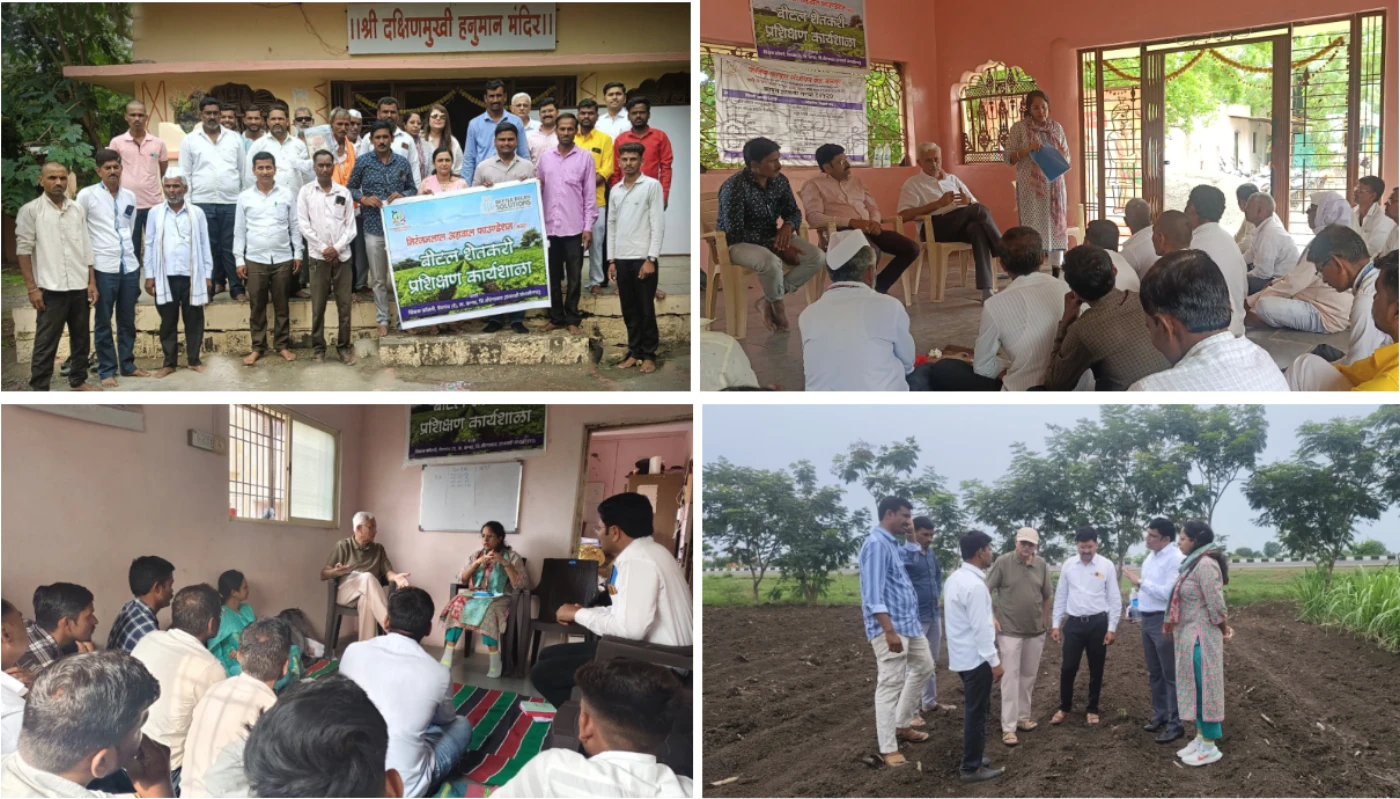
In June, our teams fanned out across villages, preparing for the upcoming kharif season. Fields and field offices once again became our classrooms, brimming with questions, experiments, and exchange.
This month's Collaborative Knowledge Building (CKB) sessions were held in Erandol (Jalgaon) and Devgaon (Aurangabad). These sessions brought together lead farmers, Regen Ambassadors (RAs), field agronomists, documentation officers, and district heads. More than just discussions, they were spaces for real-time learning and reflection-grounded in regenerative principles, but rich with practical insight from the field.
Field teams and farmers dug into what's working, what needs to improve, and how we can evolve together. Insights from our Capacity Building team added further depth to the conversations.
A key highlight? Our RAs setting self-targets for increasing adoption of regenerative practices such as intercropping, biodiversity enhancement, tree plantations, and closer plant spacing to improve cotton yields. These commitments weren't abstract goals, they emerged from the lived challenges and observations of our teams on the ground. It reminded us again: regenerative practices must be flexible and adaptive, shaped from the soil upward, not just handed down.
Carbon Insights: Net-zero goals, role of innovation, policy and farmer participation
Cotton Industry's Journey towards Net-Zero Emissions
The textile industry is one of the largest global polluters, contributing approximately 10% of global greenhouse gas (GHG) emissions annually, driven largely by fast fashion and overproduction. If the current trends continue, emissions from this sector are projected to increase by over 60% by 2030, reaching an estimated 2.8 gigatons of CO₂ equivalent per year. That's more than the combined emissions of international flights and maritime shipping.
The cotton industry is however, is stepping up its game in the race to net zero. India has pledged to slash GHG emissions by 50% per tonne of cotton lint by 2030, while the 2025 Sustainable Cotton Challenge pushes for a 35-45% cut in CO₂ from textile fibre production. read more
More Posts
Until Next Time: Let's Regenerate Together!
As we wrap up this edition of Beetle Bulletin, we hope these stories, insights, and updates have given you a deeper glimpse into the impact we are creating together. Every step we take—whether on the field, in research, or through innovation—brings us closer to a regenerative future.
Stay tuned for the next edition, and as always, we'd love to hear your thoughts, ideas, and contributions!