
Stakeholder Engagement in Regenerative Agriculture
The transition to regenerative agriculture requires more than just changing farming practices—it demands a fundamental shift in how businesses, farmers, policymakers, and supply chain partners work together. Stakeholder engagement is the cornerstone of successful regenerative agriculture programs, creating the collaborative foundation needed to address soil degradation, achieve carbon neutral goals, and build sustainable supply chains that benefit everyone involved.
According to the UN FAO, 33% of global soils are already degraded, threatening food security and accelerating climate change. Reversing this damage requires coordinated action across entire agricultural ecosystems. For textile and agriculture businesses in India and beyond, effective stakeholder engagement transforms isolated sustainability efforts into powerful, systemic change that delivers measurable environmental and economic results.
This comprehensive tutorial walks you through the step-by-step process of building stakeholder engagement programs that drive real regenerative agriculture transitions. Whether you're a textile manufacturer seeking sustainable cotton sources, a corporate sustainability team working toward Net Zero targets, or a policymaker developing climate action frameworks, this guide provides the practical tools you need to bring diverse stakeholders together for lasting impact.
Why Stakeholder Engagement Matters in Regenerative Agriculture
Regenerative agriculture operates as an interconnected system where success depends on collaboration across multiple levels. Unlike conventional farming approaches that focus on individual farm operations, regenerative practices require alignment between farmers implementing soil health improvements, manufacturers sourcing sustainable materials, retailers communicating value to consumers, and policymakers creating supportive regulatory environments.

Stakeholder engagement in this context means actively involving all parties who affect or are affected by regenerative agriculture transitions. This collaborative approach addresses several critical challenges:
- Knowledge gaps: Farmers need training on regenerative practices, while businesses need to understand how these methods impact supply chain quality and carbon sequestration potential
- Economic concerns: Transition costs and market access require shared investment and risk management across the supply chain
- Trust building: Transparent communication and data sharing create confidence in new farming methods and business relationships
- Scale and impact: Coordinated efforts achieve faster, more significant environmental results than isolated initiatives
The business case for robust stakeholder engagement is compelling. Companies that invest in collaborative regenerative agriculture programs see improved supply chain resilience, enhanced brand reputation, access to carbon credits, and progress toward corporate sustainability commitments. Farmers benefit from increased crop yield, improved soil fertility, technical support, and new revenue streams. The interconnected nature of these benefits makes stakeholder engagement not just beneficial but essential for regenerative agriculture success.
For organizations working toward carbon neutral and Net Zero goals, stakeholder engagement provides the mechanism to implement nature-based solutions at scale. By bringing together expertise from research institutions, practical knowledge from farming communities, market access from retailers, and policy support from government bodies, businesses can create regenerative agriculture programs that deliver verified carbon sequestration while strengthening agricultural communities.
1. Identify Your Key Stakeholders Across the Supply Chain
The first step in building effective stakeholder engagement programs is mapping the complete ecosystem of individuals and organizations that influence or are influenced by your regenerative agriculture initiative. This stakeholder identification process requires looking beyond obvious partners to understand the full network of relationships that will determine program success.
Primary Stakeholders: The Foundation of Your Program
Primary stakeholders are those directly involved in implementing regenerative practices and experiencing immediate impacts:
- Farmers and agricultural workers: The individuals who will adopt regenerative farming methods, manage soil health improvements, and implement carbon sequestration practices on the ground
- Farm cooperatives and farmer producer organizations: Collective groups that can facilitate knowledge sharing, coordinate training programs, and provide peer support networks
- Agricultural extension workers: Local experts who bridge the gap between research and practice, providing ongoing technical guidance
- Landowners and farm managers: Decision-makers who control land use policies and investment in regenerative transitions
Understanding primary stakeholder motivations is crucial. Farmers typically prioritize economic viability, risk reduction, and practical support. They need to see clear evidence that regenerative practices will maintain or increase crop yield while improving long-term soil fertility. Addressing these concerns upfront through your stakeholder engagement approach builds the trust necessary for successful transitions.
Secondary Stakeholders: Supply Chain Partners
Secondary stakeholders connect farm-level activities to broader markets and provide essential resources for scaling regenerative agriculture:
- Manufacturers and processors: Textile mills, cotton processors, and other businesses that source agricultural products and can commit to purchasing regeneratively grown materials
- Retailers and brands: Companies that communicate sustainability value to end consumers and can provide market incentives for regenerative products
- Input suppliers: Providers of seeds, organic amendments, and tools needed for regenerative farming practices
- Financial institutions: Banks and investors who can provide transition financing, carbon credit programs, and economic support
- Certification bodies: Organizations that verify regenerative practices and provide organic certification or other credentials
For textile industry businesses, secondary stakeholders are particularly important. Manufacturers who commit to sourcing premium regenerative cotton create market demand that motivates farmer participation. Retailers who tell compelling sustainability stories justify price premiums that support the economics of regenerative transitions. This supply chain alignment is what transforms individual farm projects into systemic change.
Tertiary Stakeholders: Enablers and Influencers
Tertiary stakeholders may not be directly involved in day-to-day operations but significantly influence the enabling environment for regenerative agriculture:
- Policymakers and government ministries: Agriculture, textile, and environment ministries that create regulatory frameworks, provide subsidies, and set sustainability standards
- Research institutions and universities: Organizations conducting soil health research, developing best practices, and providing evidence-based guidance
- NGOs and climate think tanks: Groups focused on climate advocacy, farmer capacity building, and environmental protection
- Industry associations: Textile industry groups, agricultural associations, and sustainability coalitions that shape sector-wide approaches
- Consumers and civil society: End users whose purchasing decisions and advocacy influence market demand for sustainable products
Engaging tertiary stakeholders expands your program's impact and sustainability. Policymakers can create supportive regulations that reduce barriers to regenerative agriculture adoption. Research institutions provide the scientific credibility that builds confidence among skeptical stakeholders. NGOs bring expertise in farmer training and community engagement that accelerates implementation.
Creating Your Stakeholder Matrix
Once you've identified stakeholders, organize them using a stakeholder matrix that maps their level of influence and interest in your regenerative agriculture program. This prioritization tool helps you allocate engagement resources effectively:
- High influence, high interest: Key partners requiring intensive engagement and collaboration (e.g., major suppliers, lead farmers, primary manufacturing partners)
- High influence, low interest: Important stakeholders needing targeted communication to increase engagement (e.g., policymakers, large retailers)
- Low influence, high interest: Supportive stakeholders who can amplify your message and provide grassroots support (e.g., local NGOs, farming communities)
- Low influence, low interest: Stakeholders requiring basic information and monitoring (e.g., peripheral suppliers, general public)
This stakeholder mapping process should be revisited regularly as your regenerative agriculture program evolves. Stakeholder interests and influence levels change over time, and your engagement strategy must adapt accordingly.
2. Assess Stakeholder Needs and Establish Common Goals
After identifying your stakeholders, the next critical step is understanding what each group needs from your regenerative agriculture program and finding the common ground that will unite diverse interests. This assessment phase prevents misalignment and builds the shared vision necessary for effective stakeholder engagement.
Begin by conducting structured stakeholder consultations. For farmers, this might involve focus group discussions in local languages, farm visits to understand current practices, and surveys about concerns regarding regenerative transitions. For corporate stakeholders, conduct interviews with sustainability teams, procurement departments, and executive leadership to understand business priorities and constraints.
Understanding Diverse Stakeholder Priorities
Different stakeholder groups bring distinct priorities to regenerative agriculture programs:
Farmers and agricultural workers typically prioritize immediate economic viability, risk management, and practical support. Their key concerns include: Will regenerative practices maintain my income during the transition period? What training and technical support will I receive? How will I access markets for regeneratively grown products? Can I afford the initial investment required?
Textile manufacturers and brands focus on supply chain reliability, quality consistency, sustainability credentials, and cost implications. They ask: Can regenerative agriculture provide the volume and quality of cotton we need? How do we verify and communicate the sustainability benefits? What is the business case for paying premium prices? How does this support our Net Zero commitments?
Policymakers and government bodies consider broader societal impacts, including food security, rural livelihoods, climate action targets, and economic development. Their questions include: How does regenerative agriculture contribute to national climate goals? What policy support is needed to scale these practices? How do we balance agricultural productivity with environmental protection?
Financial stakeholders evaluate return on investment, risk profiles, and measurable outcomes. They need to understand: What are the economic returns from regenerative agriculture investments? How do we quantify carbon sequestration benefits? What are the risks and mitigation strategies?
Identifying Shared Objectives
Despite diverse priorities, most stakeholders share common goals that provide the foundation for collaborative engagement:
- Long-term sustainability: All stakeholders benefit from agricultural systems that remain productive and profitable over decades rather than degrading soil and requiring increasing inputs
- Climate action: Regenerative agriculture's carbon sequestration potential supports corporate Net Zero goals, national climate commitments, and global environmental targets
- Economic resilience: Improved soil health leads to better crop yield, reduced input costs, and more stable agricultural incomes that benefit entire supply chains
- Risk reduction: Diversified farming systems and healthier soils create resilience against climate variability, market fluctuations, and supply chain disruptions
- Social impact: Farmer training and capacity building programs strengthen rural communities and create shared value across the agricultural ecosystem
Frame your stakeholder engagement program around these shared objectives while acknowledging and addressing specific stakeholder concerns. This approach creates buy-in across diverse groups by demonstrating how regenerative agriculture serves multiple interests simultaneously.
Establishing Baseline Metrics
Effective stakeholder engagement requires transparent measurement of progress toward shared goals. Establish baseline metrics before implementing regenerative practices:
- Soil health indicators: Organic matter content, soil structure, microbial activity, water retention capacity
- Carbon metrics: Current carbon emissions, sequestration potential, progress toward carbon neutral targets
- Economic data: Current crop yield, input costs, farmer income, supply chain costs
- Environmental measures: Water usage, biodiversity indicators, chemical input levels
- Social metrics: Farmer satisfaction, knowledge levels, community engagement, training participation
These baseline measurements provide the evidence-based foundation that builds stakeholder confidence and enables transparent reporting on program outcomes. For businesses working toward corporate sustainability goals, this data integration supports ESG reporting and demonstrates tangible progress. Learn more about measuring these impacts in our guide on carbon sequestration in agriculture.
3. Design Your Collaborative Engagement Framework
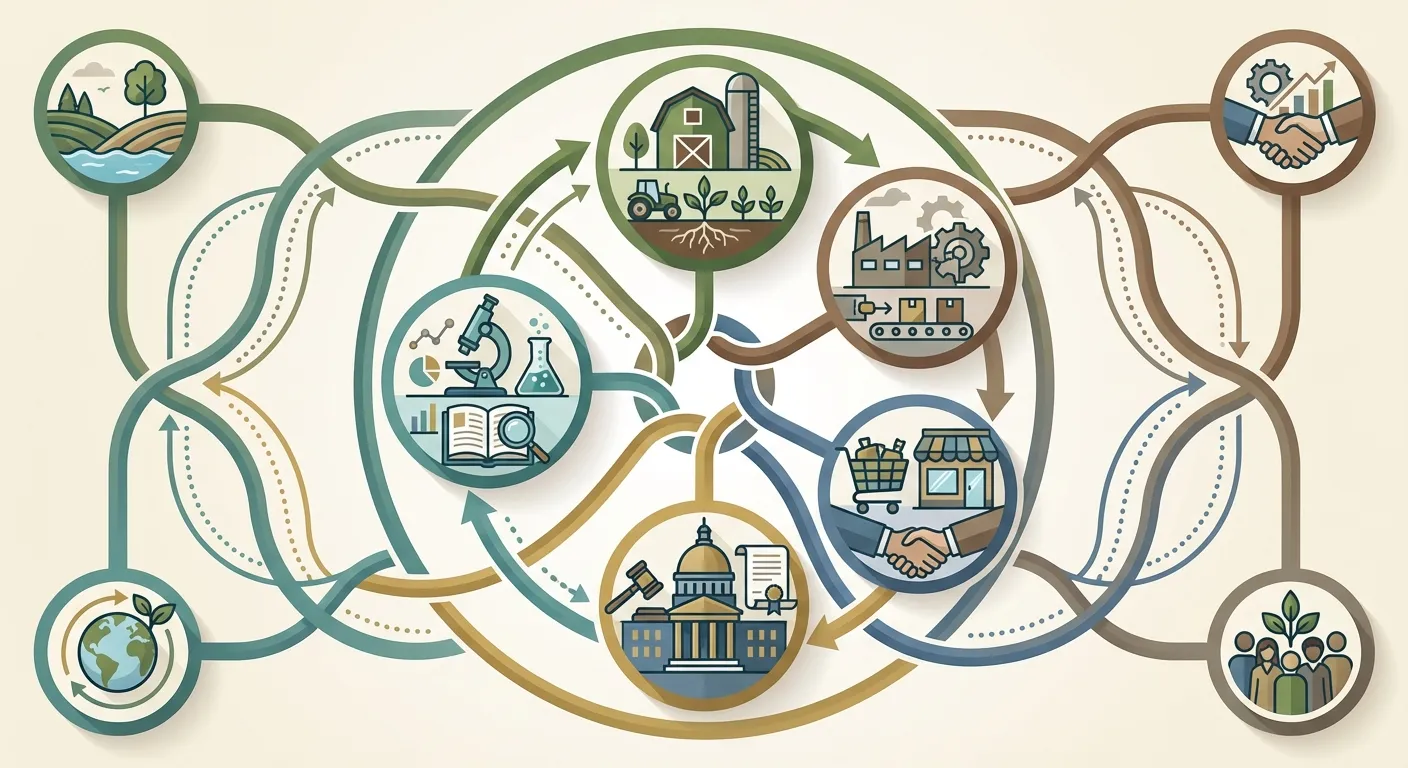
With stakeholders identified and shared goals established, the next step is designing the structures and processes that will facilitate ongoing collaboration. A well-designed engagement framework creates the channels, platforms, and mechanisms that transform stakeholder relationships from transactional interactions into genuine partnerships for regenerative agriculture transformation.
Multi-Stakeholder Platforms for Knowledge Sharing
Create dedicated platforms where diverse stakeholders can share knowledge, coordinate activities, and build collective understanding. These platforms take various forms depending on your program's scale and stakeholder composition:
Collaborative forums and working groups bring together representatives from different stakeholder categories to address specific challenges. For example, a technical working group might include farmers, agronomists, and researchers developing best practices for soil health improvement in specific crop systems. A supply chain working group could connect farmers, processors, manufacturers, and retailers to coordinate sustainable sourcing commitments.
Organizations like Beetle Regen Solutions facilitate platforms such as the Climate Action Textile Forum, which creates space for textile industry stakeholders to collaborate on regenerative agriculture solutions. These multi-stakeholder platforms accelerate learning, prevent duplication of efforts, and build the trust necessary for long-term partnerships.
Digital collaboration tools enable ongoing communication and data sharing between in-person meetings. Online platforms can host training resources, share soil health data, coordinate logistics, and facilitate peer-to-peer learning among farmers. For businesses managing complex supply chains, digital tools provide transparency and traceability that verify regenerative practices and support sustainability reporting.
Communication Channels and Feedback Mechanisms
Effective stakeholder engagement requires two-way communication that allows all parties to share information, raise concerns, and provide input on program direction. Design communication channels appropriate for different stakeholder groups:
- Regular stakeholder meetings: Quarterly or monthly gatherings that provide updates, discuss challenges, and make collective decisions
- Field visits and farm demonstrations: Hands-on opportunities for supply chain partners to see regenerative practices in action and interact directly with farmers
- Digital newsletters and updates: Regular communication keeping all stakeholders informed of program progress, success stories, and upcoming activities
- Feedback surveys and consultations: Structured opportunities for stakeholders to provide input on program design and implementation
- Grievance mechanisms: Clear processes for addressing concerns, resolving conflicts, and ensuring all stakeholder voices are heard
The key is creating communication channels that are accessible and appropriate for each stakeholder group. Farmers may prefer in-person meetings in local languages, while corporate partners might engage more effectively through digital platforms and formal reports. Successful stakeholder engagement adapts communication methods to stakeholder preferences rather than imposing one-size-fits-all approaches.
Farmer Training and Capacity Building Programs
At the heart of regenerative agriculture stakeholder engagement are comprehensive farmer training programs that build the knowledge and skills necessary for successful transitions. These capacity building initiatives represent the practical implementation of collaborative engagement, bringing together expertise from research institutions, practical guidance from experienced practitioners, and peer support from farming communities.
Collaborative knowledge building sessions move beyond traditional top-down training to create learning environments where farmers, agronomists, and researchers share insights and co-develop solutions. This approach recognizes that farmers bring valuable traditional knowledge and practical experience that complements scientific expertise. Sessions might cover topics such as:
- Soil health assessment and improvement techniques
- Cover cropping and crop rotation strategies for carbon sequestration
- Organic amendments and natural fertility management
- Water conservation and management practices
- Integrated pest management and biodiversity enhancement
- Record-keeping and data collection for carbon credit programs
Hands-on training and demonstration farms provide practical learning opportunities where farmers can see regenerative practices in action before implementing them on their own land. Demonstration sites reduce risk perception and build confidence by showing real results in local conditions. These farms become hubs for peer-to-peer learning and ongoing stakeholder engagement.
Ongoing technical support ensures farmers have access to expert guidance throughout the transition process. This might include regular farm visits from agricultural extension workers, hotlines for troubleshooting challenges, and peer support networks where farmers can share experiences and solutions. The goal is creating a support ecosystem that reduces the isolation and risk that often prevent farmers from adopting new practices.
Organizations like Beetle Regen Solutions specialize in these collaborative capacity building programs, providing evidence-based, data-led training that connects farmers with the resources and knowledge they need for successful regenerative transitions. This investment in farmer training is what transforms stakeholder engagement from abstract collaboration into tangible agricultural transformation.
Transparent Data Sharing Protocols
Trust is the foundation of effective stakeholder engagement, and transparency is how you build that trust. Establish clear protocols for collecting, sharing, and using data related to your regenerative agriculture program:
- Soil health monitoring: Regular testing and transparent reporting of soil organic matter, nutrient levels, and biological activity
- Carbon accounting: Verified measurement of carbon sequestration using standardized methodologies
- Economic tracking: Documentation of costs, yields, and economic outcomes for participating farmers
- Supply chain traceability: Systems that track regeneratively grown products from farm to final product
- Impact reporting: Regular updates on environmental, economic, and social outcomes shared with all stakeholders
Data integration tools enable this transparency while protecting farmer privacy and business confidentiality. The goal is providing stakeholders with the information they need to evaluate program effectiveness and make informed decisions while maintaining appropriate data security. For more on implementing these systems, explore our article on supply chain transformation through regenerative agriculture consulting.
4. Implement Engagement Activities and Pilot Programs
With your engagement framework designed, it's time to move from planning to action. Implementation should begin with carefully designed pilot programs that test your stakeholder engagement approach, demonstrate results, and build momentum for broader scaling. This phased approach reduces risk and allows you to refine your methods based on real-world experience.
Launching Pilot Projects with Early Adopters
Identify a group of early adopter farmers who are willing to implement regenerative practices and serve as demonstration sites for your stakeholder engagement program. These pioneers should be respected within their communities, open to innovation, and representative of the broader farming population you aim to reach.
Pilot projects typically involve 10-50 farmers working on 100-500 acres, providing enough scale to demonstrate impact while remaining manageable for intensive support and monitoring. Select pilot locations that represent different soil types, crop systems, and farming contexts relevant to your broader program goals.
Provide pilot participants with comprehensive support including intensive training, regular technical assistance, input support if needed, and guaranteed market access for their regeneratively grown products. This high-touch approach ensures pilot success and generates the compelling results that will attract additional stakeholders to your program.
Organizing Regular Stakeholder Meetings and Workshops
Establish a rhythm of regular stakeholder engagement activities that maintain momentum and build relationships over time:
Quarterly stakeholder forums bring together representatives from all stakeholder groups to review progress, discuss challenges, and make collective decisions about program direction. These forums should include presentations on pilot results, farmer testimonials, technical updates, and open discussion sessions where stakeholders can raise concerns and provide input.
Technical workshops provide deeper dives into specific topics relevant to different stakeholder groups. A workshop for textile manufacturers might focus on quality characteristics of regeneratively grown cotton and supply chain integration. A workshop for policymakers might examine how regenerative agriculture contributes to national climate commitments and what policy support would accelerate adoption.
Farmer field days invite supply chain partners, policymakers, and other stakeholders to visit demonstration farms and see regenerative practices firsthand. These events create powerful connections between stakeholders who might otherwise remain distant from farm-level realities. When a textile brand executive stands in a regenerative cotton field and hears directly from farmers about their experiences, it transforms abstract sustainability commitments into personal relationships and genuine understanding.
Facilitating Supply Chain Transparency Initiatives
Create opportunities for stakeholders to understand and engage with the full supply chain connecting regenerative farms to final products:
- Supply chain visits: Organize tours that follow regeneratively grown cotton from farm through processing, manufacturing, and retail, allowing stakeholders to see how their role connects to the broader system
- Traceability systems: Implement technologies that track regenerative products through the supply chain, providing transparency and verification
- Collaborative sourcing agreements: Facilitate long-term commitments between farmers and buyers that provide market security and justify regenerative transitions
- Premium pricing mechanisms: Establish clear systems for how regenerative practices translate into price premiums that reward farmer efforts
For textile industry businesses, these supply chain transparency initiatives are particularly valuable. They provide the verification needed for sustainability marketing claims while building the direct relationships that create resilient, ethical supply chains. This transparency is what transforms conventional sourcing into genuine stakeholder engagement that benefits all parties.
Establishing Carbon Credit Programs and Economic Incentives
Economic viability is essential for sustainable stakeholder engagement. Develop clear mechanisms that translate environmental benefits into economic value for participating farmers:
Carbon credit programs provide revenue streams based on verified carbon sequestration achieved through regenerative practices. These programs require robust measurement, reporting, and verification systems, but they create powerful economic incentives that support farmer transitions. Organizations like Beetle Regen Solutions can help businesses establish carbon credit programs that connect regenerative agriculture to corporate Net Zero goals while providing farmer income.
Premium pricing for regenerative products ensures that farmers receive fair compensation for the additional effort and environmental benefits of regenerative practices. Work with supply chain partners to establish transparent pricing mechanisms that share value equitably across the supply chain.
Input support and transition financing help farmers manage the upfront costs of transitioning to regenerative practices. This might include subsidized organic amendments, equipment sharing programs, or low-interest loans for regenerative investments. For more on the economic benefits, see our analysis of regenerative agriculture vs. conventional farming ROI in 2026.
5. Measure Impact and Communicate Results
Effective stakeholder engagement requires demonstrating tangible results that justify continued investment and participation. Robust measurement and transparent communication of outcomes build stakeholder confidence, attract new participants, and provide the evidence base for scaling your regenerative agriculture program.
Tracking Key Performance Indicators
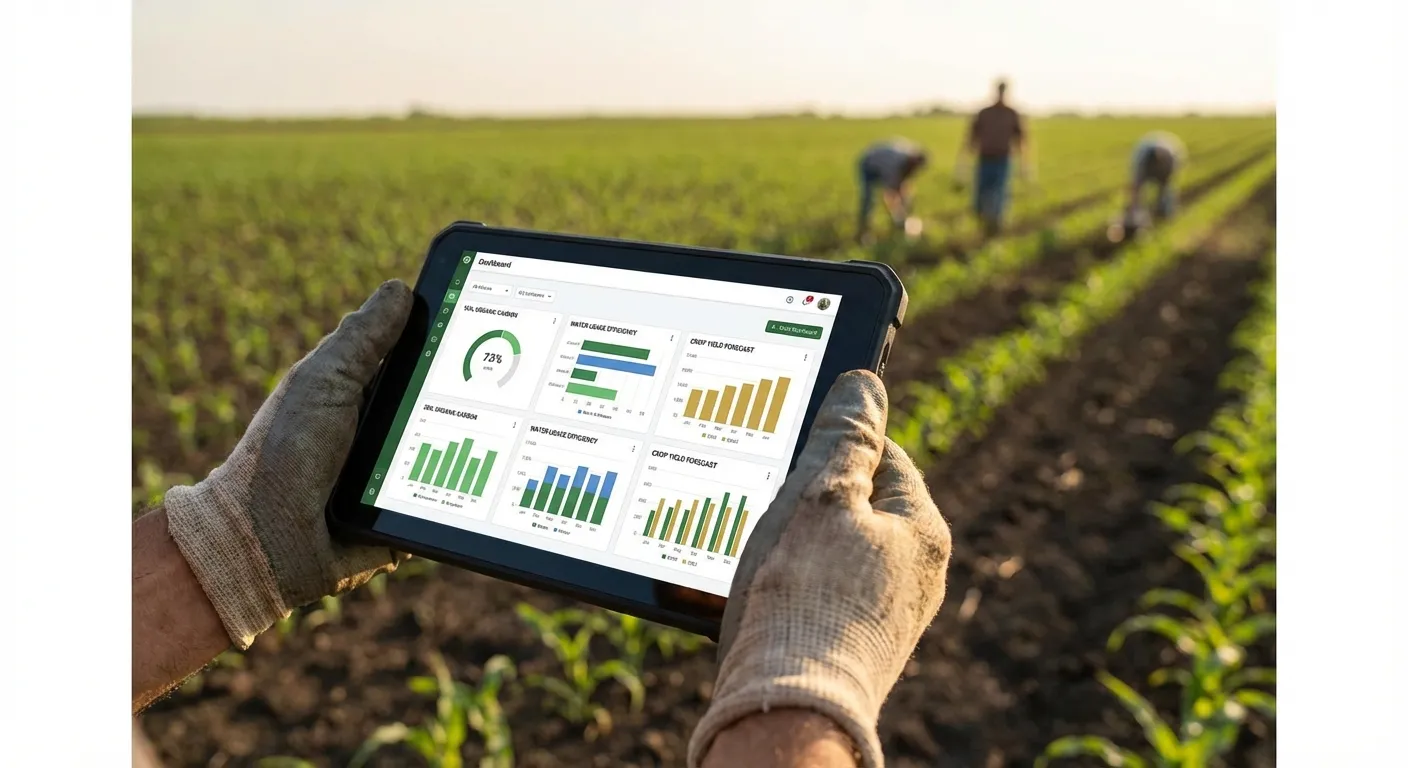
Implement comprehensive monitoring systems that track progress across environmental, economic, and social dimensions:
Soil health metrics provide the foundation for evaluating regenerative agriculture success. Regular soil testing should measure organic matter content, soil structure, nutrient availability, microbial biomass, and water infiltration rates. These indicators demonstrate the biological and physical improvements that underpin all other benefits of regenerative practices. Aim for annual soil testing with more frequent monitoring during the initial transition period.
Carbon sequestration rates quantify climate benefits and support carbon credit programs. Use standardized methodologies to measure carbon stored in soil organic matter and above-ground biomass. This data is essential for businesses working toward carbon neutral and Net Zero goals, providing verified evidence of climate action. Typical regenerative agriculture systems sequester 0.5-2 tons of carbon per acre annually, though rates vary based on practices and conditions.
Crop yield and quality measurements address the critical question of whether regenerative practices maintain or improve agricultural productivity. Track yields over multiple seasons to account for transition periods and weather variability. Many regenerative systems show initial yield stability followed by improvements as soil health builds. Quality metrics might include fiber length and strength for cotton, protein content for grains, or other crop-specific characteristics.
Economic indicators demonstrate financial viability for all stakeholders. For farmers, track income, input costs, labor requirements, and return on investment. For supply chain partners, monitor sourcing costs, supply reliability, and value creation from sustainability positioning. Economic data should show how regenerative agriculture creates shared value rather than simply shifting costs between stakeholders.
Stakeholder engagement metrics assess the health and effectiveness of your collaborative processes. Track participation rates in training programs, stakeholder satisfaction scores, retention of participating farmers, and growth in stakeholder network size. These metrics reveal whether your engagement approach is building the strong relationships necessary for long-term success.
Documenting Economic Benefits Across the Supply Chain
Create clear documentation of how regenerative agriculture generates value for different stakeholder groups. This economic storytelling is essential for attracting new participants and securing continued investment:
- Farmer benefits: Reduced input costs, improved yields over time, premium pricing, carbon credit revenue, improved soil fertility as a long-term asset
- Manufacturer benefits: Secure supply of sustainable materials, quality improvements, reduced supply chain risk, support for sustainability commitments
- Retailer benefits: Compelling sustainability stories, brand differentiation, consumer loyalty, progress toward corporate climate goals
- Societal benefits: Climate action through carbon sequestration, improved rural livelihoods, reduced soil degradation, enhanced food security
Quantify these benefits wherever possible. Instead of saying "farmers benefit from improved soil health," report "participating farmers saw a 15% reduction in fertilizer costs and a 20% improvement in drought resilience over three years." Specific, data-driven results build credibility and demonstrate the tangible value of stakeholder engagement in regenerative agriculture.
Sharing Success Stories and Case Studies
Numbers tell part of the story, but personal narratives create emotional connections that motivate stakeholder engagement. Develop case studies that highlight individual farmer experiences, supply chain transformation stories, and collaborative successes:
Feature farmers who have successfully transitioned to regenerative practices, describing their initial concerns, the support they received, challenges they overcame, and results they achieved. These stories make abstract concepts concrete and provide peer validation that encourages other farmers to participate.
Document supply chain partnerships that demonstrate how collaboration creates value for all parties. Show how a textile manufacturer's commitment to sourcing regenerative cotton provided market security that enabled farmer transitions, while the manufacturer gained sustainable materials that enhanced brand reputation and supported Net Zero goals.
Share these stories through multiple channels: stakeholder meetings, digital platforms, industry conferences, policy forums, and public communications. Different stakeholders will resonate with different aspects of your program, so diverse storytelling ensures broad engagement.
Transparent Reporting and Data Integration
Establish regular reporting cycles that keep all stakeholders informed of program progress. Quarterly reports might provide updates on pilot activities, training participation, and preliminary results. Annual reports should include comprehensive data on environmental outcomes, economic impacts, and stakeholder engagement metrics.
Use data integration tools that allow stakeholders to access relevant information in real-time while maintaining appropriate privacy and confidentiality. A farmer might access their own soil health data and compare it to anonymized benchmarks. A corporate partner might view aggregated carbon sequestration data across their supply chain. Policymakers might access regional data showing the collective impact of regenerative agriculture programs.
This transparency builds trust and accountability while providing stakeholders with the information they need to make informed decisions about continued participation and investment. It transforms stakeholder engagement from a feel-good collaboration into a data-driven partnership with measurable outcomes.
6. Scale and Sustain Your Stakeholder Engagement Program
Once pilot programs demonstrate success, the challenge shifts to scaling your stakeholder engagement approach while maintaining the quality of relationships and support that enabled initial results. Sustainable scaling requires strategic planning, continued stakeholder commitment, and integration into broader business and policy frameworks.
Expanding Successful Pilots to Broader Networks
Use your pilot results as the foundation for geographic and network expansion. Early adopter farmers become champions who recruit peers and provide mentorship to new participants. Demonstration farms become training sites for broader farmer networks. Supply chain partners who participated in pilots become advocates who encourage industry-wide adoption.
Expansion should be strategic rather than simply rapid. Prioritize regions and networks where you have strong stakeholder relationships, appropriate support infrastructure, and market access for regeneratively grown products. It's better to expand methodically with high success rates than to scale quickly and see participation collapse due to inadequate support.
Consider a hub-and-spoke model where successful pilot sites become regional hubs that support surrounding farming communities. This approach leverages peer learning and local knowledge while maintaining quality standards and stakeholder engagement practices that drove initial success.
Securing Long-Term Commitments from Supply Chain Partners
Sustainable stakeholder engagement requires moving beyond short-term projects to long-term partnerships embedded in business strategy. Work with supply chain partners to establish multi-year commitments that provide the stability necessary for regenerative transitions:
- Long-term sourcing agreements: Contracts that commit to purchasing regeneratively grown products over 3-5 years, providing farmers with market security
- Shared investment models: Partnerships where supply chain partners co-invest in farmer training, soil health improvements, and infrastructure development
- Collaborative goal-setting: Joint targets for expanding regenerative agriculture acreage, carbon sequestration, and supply chain sustainability
- Integrated sustainability strategies: Embedding regenerative agriculture into corporate sustainability plans, ESG reporting, and Net Zero roadmaps
These long-term commitments transform stakeholder engagement from a project-based initiative into a fundamental aspect of how businesses operate. For textile companies, this might mean committing to source 50% of cotton from regenerative systems by 2030. For agricultural businesses, it might mean transitioning entire supply sheds to regenerative practices over a five-year period.
Advocating for Supportive Policies
Engage with policymakers and government bodies to create enabling environments that support regenerative agriculture at scale. Your stakeholder engagement program generates valuable insights and evidence that can inform policy development:
Share data on regenerative agriculture's contributions to climate action, demonstrating how these practices support national commitments under the Paris Agreement and domestic climate goals. Provide evidence of economic benefits for rural communities, showing how regenerative agriculture creates livelihoods while addressing environmental challenges.
Advocate for specific policy support including subsidies for regenerative transitions, technical assistance programs, research funding, supportive regulations for organic certification and carbon markets, and public procurement preferences for regeneratively grown products. Engage with agriculture, textile, and environment ministries to ensure policies align across sectors.
Organizations like Beetle Regen Solutions work with climate think tanks and policy makers to translate on-the-ground experience into policy recommendations that accelerate regenerative agriculture adoption. This policy engagement is a critical dimension of stakeholder engagement that creates systemic change beyond individual programs.
Building Circular Economy Models
Integrate your stakeholder engagement program into broader circular economy frameworks that maximize resource efficiency and create closed-loop systems. For textile industry stakeholders, this might involve connecting regenerative cotton production with textile recycling initiatives, creating systems where end-of-life textiles return nutrients to agricultural soils.
Circular economy approaches strengthen stakeholder engagement by creating additional value streams and demonstrating how regenerative agriculture fits into comprehensive sustainability strategies. They also attract new stakeholders including waste management companies, recycling innovators, and circular economy advocates who expand your collaborative network. Learn more about these connections in our article on circular economy in fashion.
Overcoming Common Stakeholder Engagement Challenges
Even well-designed stakeholder engagement programs face predictable challenges. Anticipating these obstacles and developing strategies to address them increases your program's resilience and long-term success.
Addressing Resistance to Change
Farmers and other stakeholders may be skeptical about regenerative agriculture, particularly if they've experienced failed agricultural innovations in the past. This resistance is rational risk management, not obstinacy. Address it through:
- Demonstration and evidence: Show rather than tell by providing opportunities to see successful regenerative farms and meet farmers who have benefited from transitions
- Risk mitigation: Offer transition support, guaranteed market access, and insurance against yield losses during the learning period
- Incremental adoption: Allow farmers to test regenerative practices on small portions of their land before committing to full transitions
- Peer influence: Leverage respected community members and early adopters to share their experiences and encourage participation
For corporate stakeholders, resistance often stems from concerns about supply chain disruption, cost increases, or unproven sustainability claims. Address these concerns with transparent data, pilot results, and clear business cases that demonstrate how regenerative agriculture supports rather than threatens business objectives.
Navigating Conflicting Stakeholder Priorities
Different stakeholders inevitably have competing interests. Farmers want maximum prices while manufacturers seek cost control. Policymakers balance environmental goals with economic development. Retailers want sustainability credentials without supply chain complexity.
Effective stakeholder engagement doesn't eliminate these tensions but creates processes for negotiating them constructively. Use your multi-stakeholder platforms to facilitate open discussions about trade-offs and compromises. Focus on shared goals and win-win solutions rather than zero-sum negotiations. When conflicts arise, return to the common objectives that brought stakeholders together in the first place.
Sometimes conflicts reveal genuine incompatibilities that require difficult decisions. A stakeholder whose priorities fundamentally contradict regenerative agriculture principles may not be the right partner. It's better to acknowledge this early than to compromise program integrity trying to accommodate incompatible interests.
Managing Resource Constraints
Comprehensive stakeholder engagement requires significant resources including staff time, training budgets, monitoring systems, and coordination infrastructure. Resource constraints are a common challenge, particularly for programs trying to scale rapidly.
Address resource limitations through strategic prioritization, leveraging existing infrastructure, and creative partnership models. Focus intensive support on high-priority stakeholders and pilot regions while using digital tools and peer networks to extend reach more efficiently. Partner with research institutions, NGOs, and government programs that can provide complementary resources and expertise.
Consider how organizations like Beetle Regen Solutions can provide specialized expertise in farmer training, carbon accounting, and supply chain integration, allowing you to access professional capacity without building all capabilities in-house. Strategic partnerships multiply your resources and accelerate program development.
Maintaining Long-Term Momentum
Stakeholder engagement requires sustained effort over years, not months. Initial enthusiasm can fade as programs move from exciting launches to the hard work of implementation. Maintain momentum through:
- Regular communication: Keep stakeholders engaged with consistent updates, success stories, and opportunities for input
- Celebrating milestones: Recognize achievements, honor contributions, and mark progress toward shared goals
- Refreshing leadership: Rotate stakeholder representatives, bring in new voices, and prevent engagement fatigue
- Demonstrating impact: Continuously share data and stories that show how stakeholder engagement is creating real change
- Evolving the program: Adapt your approach based on stakeholder feedback and changing circumstances rather than rigidly following initial plans
The most successful stakeholder engagement programs become self-sustaining as relationships deepen, trust builds, and stakeholders see tangible benefits from their participation. This transformation from externally driven initiative to self-organizing network is the ultimate goal of effective stakeholder engagement.
Real-World Applications: Stakeholder Engagement in Textile and Agriculture Industries
Understanding stakeholder engagement principles is valuable, but seeing how they apply in specific industry contexts makes them actionable. The textile and agriculture industries present unique opportunities and challenges for regenerative agriculture stakeholder engagement.
Textile Industry Stakeholder Engagement Models
The textile industry's complex global supply chains require sophisticated stakeholder engagement approaches that connect cotton farmers in rural India with fashion brands selling to consumers worldwide. Successful models typically involve:
Brand-led initiatives where major textile companies commit to sourcing regenerative cotton and work backward through their supply chains to engage farmers. These brands provide market demand and premium pricing that motivate farmer participation while gaining sustainability credentials that resonate with conscious consumers.
Industry collaborations like the Climate Action Textile Forum bring together multiple brands, manufacturers, and suppliers to coordinate regenerative agriculture efforts. These collaborative platforms prevent duplication, share best practices, and create industry-wide standards that accelerate adoption. They also provide smaller players with access to resources and expertise they couldn't develop independently.
Integrated supply chain partnerships connect all stakeholders from farm to retail in long-term relationships. A textile manufacturer might partner with specific farming communities, providing training and inputs while committing to purchase their regenerative cotton. Retailers then commit to sourcing from these manufacturers, creating a complete value chain aligned around regenerative principles.
Organizations like Beetle Regen Solutions facilitate these textile industry stakeholder engagement programs, providing the technical expertise in regenerative agriculture, farmer training capacity, and supply chain coordination that makes complex partnerships work. Their role as neutral conveners and technical experts helps bridge the knowledge and cultural gaps between textile businesses and farming communities.
Agricultural Industry Applications
For agricultural businesses and farmer cooperatives, stakeholder engagement focuses on building peer networks, accessing technical support, and connecting to markets:
Farmer producer organizations serve as key stakeholder engagement hubs, aggregating individual farmers into collective groups that can access training, negotiate better prices, and coordinate regenerative transitions. These organizations provide the social infrastructure that makes stakeholder engagement practical at scale.
Research partnerships connect farmers with universities and agricultural research institutions that provide evidence-based guidance on regenerative practices adapted to local conditions. These partnerships ensure that farmer training is grounded in science while incorporating traditional knowledge and practical experience.
Input supplier collaborations engage companies providing seeds, organic amendments, and equipment in supporting regenerative transitions. Rather than simply selling products, these suppliers become partners in farmer success, providing technical advice and developing products specifically designed for regenerative systems.
Policy Engagement Examples
Effective stakeholder engagement extends to government bodies and policymakers who shape the enabling environment for regenerative agriculture:
Engage with agriculture ministries to demonstrate how regenerative practices address soil degradation while maintaining food security. Provide data showing that regenerative systems can match or exceed conventional yields while improving long-term soil fertility. This evidence helps policymakers see regenerative agriculture as a solution rather than a trade-off.
Work with textile ministries to show how regenerative agriculture supports industry sustainability goals and creates competitive advantages in global markets increasingly focused on environmental credentials. Position regenerative agriculture as an economic opportunity rather than just an environmental obligation.
Collaborate with environment ministries and climate think tanks to quantify regenerative agriculture's contributions to national climate commitments. Demonstrate how supporting regenerative transitions is a cost-effective climate action strategy that delivers co-benefits for rural livelihoods and agricultural productivity.
These policy engagement efforts create supportive frameworks that accelerate regenerative agriculture adoption beyond what individual programs can achieve. They represent stakeholder engagement at the systemic level, shaping the rules and incentives that govern entire sectors.
Taking the Next Step in Stakeholder Engagement for Regenerative Agriculture
Building effective stakeholder engagement programs for regenerative agriculture is not a simple or quick process, but it is essential for creating the systemic change needed to address soil degradation, achieve climate goals, and build sustainable supply chains. The step-by-step approach outlined in this tutorial provides a roadmap from initial stakeholder identification through scaling and sustaining collaborative programs that deliver measurable environmental, economic, and social benefits.
The key insights to remember as you develop your stakeholder engagement strategy:
- Stakeholder engagement is not optional—regenerative agriculture requires collaboration across farmers, businesses, policymakers, and communities to succeed at scale
- Start with thorough stakeholder mapping that identifies all parties who influence or are affected by your regenerative agriculture program
- Invest time in understanding diverse stakeholder needs and finding the common goals that unite different interests
- Design collaborative frameworks that create genuine partnerships rather than transactional relationships
- Prioritize farmer training and capacity building as the practical foundation of stakeholder engagement
- Measure and communicate results transparently to build trust and demonstrate value
- Plan for long-term sustainability through policy engagement, circular economy integration, and embedded business commitments
- Anticipate and address challenges proactively rather than waiting for resistance and conflicts to derail your program
For textile and agriculture businesses, corporate sustainability teams, and policymakers working toward carbon neutral and Net Zero goals, stakeholder engagement in regenerative agriculture offers a proven pathway to meaningful climate action. The collaborative approaches described in this tutorial create shared value across supply chains while addressing urgent environmental challenges like soil degradation and carbon emissions.
Organizations like Beetle Regen Solutions specialize in facilitating these complex stakeholder engagement programs, providing the technical expertise, farmer training capacity, and collaborative platforms that transform abstract sustainability commitments into on-the-ground regenerative agriculture transitions. Their evidence-based, data-led approach ensures that stakeholder engagement delivers measurable results while building the trust and relationships necessary for long-term success.
Whether you're taking the first steps toward regenerative agriculture or looking to scale existing initiatives, effective stakeholder engagement is what will determine your program's impact and sustainability. The investment in building genuine collaborative partnerships pays dividends through stronger supply chains, enhanced environmental outcomes, improved farmer livelihoods, and progress toward your organization's sustainability goals.
Ready to build stakeholder engagement programs that drive real regenerative agriculture transformation? Contact Beetle Regen Solutions to learn how their collaborative capacity building programs, technical expertise, and industry partnerships can help you create stakeholder engagement strategies that deliver measurable environmental and economic results across your supply chain. Start your journey toward sustainable farming practices and carbon neutral goals through proven stakeholder engagement approaches that benefit farmers, businesses, and the planet.