
How Smallholder Farmers can Sell Carbon Credits in India: A Plain-Language Walkthrough
Raju Patil farms 2.3 acres of cotton in Vidarbha, Maharashtra. Last year, a program coordinator visited his village and told him he could earn additional income by changing how he manages his soil. The coordinator mentioned "carbon credits." Raju nodded politely and had no idea what that meant.
That gap — between a real financial opportunity and the language used to describe it — is the single biggest barrier keeping Indian smallholder farmers out of the voluntary carbon market. This guide closes that gap. It walks through every step of how smallholder farmers can sell carbon credits in India: what qualifies, how aggregation works, what verification involves, and how to make sure the money actually reaches the farmer.

Why Carbon Credits Feel Out of Reach for Small Farmers — and Why That's Changing
A carbon credit represents one tonne of carbon dioxide equivalent (CO₂e) that has either been removed from the atmosphere or prevented from entering it. When a farmer adopts practices that build organic matter in the soil, cover cropping, reduced tillage, biochar application, that carbon gets measured, verified, and converted into credits that companies buy to meet their climate commitments.
For most of its history, the voluntary carbon market rewarded scale. Large forestry projects, industrial methane capture, and utility-scale renewable energy dominated the registries. A farmer with two acres in Telangana had no practical way in. The transaction costs of measuring, verifying, and registering credits from a single small plot were simply too high relative to the revenue generated.
Two things have changed that equation. First, aggregation models now pool hundreds or thousands of smallholders into a single project, spreading fixed costs across a much larger land base. Second, methodology updates from registries like Verra and Gold Standard have made it easier to apply standardized measurement approaches to smallholder agriculture, reducing the cost of monitoring, reporting, and verification (MRV) significantly.
The result: a farmer with one to five acres can now participate in a carbon program, provided they join the right aggregation structure and work with a program partner who understands both the technical requirements and the farmer's interests. The opportunity is real. But so are the risks of entering a poorly designed program. Understanding the full process is the first line of protection.
Step 1: Check Your Eligibility Before Anything Else
Not every farm and not every farmer will qualify for a carbon credit program. Before investing time or changing practices, it is worth running through the basic eligibility criteria that most programs apply.
Land Size and Tenure
Most aggregated programs accept individual plots as small as one acre, provided the total project area across all enrolled farmers reaches a viable threshold (typically 500 to 1,000 acres minimum for a project to be economically feasible). More important than size is documented land tenure. You will need patta documents, land records (7/12 extract in Maharashtra, ROR in other states), and ideally Aadhaar-linked land registration. Sharecroppers and tenant farmers face additional complexity, some programs accept them with a formal tenancy agreement, others do not. Clarify this upfront.
Baseline Land Use
Carbon programs measure the difference between what your land was doing before the program and what it does after. This is called the baseline. If you have already been practicing no-till farming or applying compost for the past five years, the "additionality" of your practice change may be limited, meaning fewer credits can be claimed. Farmers transitioning from conventional tillage and synthetic input-heavy systems typically have the strongest baseline contrast and therefore the highest credit potential.
Eligible Crop Types and Geographies
Active programs in India currently cover cotton (Maharashtra, Telangana, Madhya Pradesh, Gujarat), paddy/rice (West Bengal, Odisha, Assam, Andhra Pradesh), pulses and mixed cropping systems, and agroforestry. States with the most active program infrastructure as of 2026 include Maharashtra, Telangana, Madhya Pradesh, Odisha, and West Bengal. If you farm in these regions, your chances of finding an active aggregation program are highest.
Step 2: Understand the Methodology That Will Govern Your Credits
A methodology is the rulebook that defines which practices generate credits, how carbon is measured, and what documentation is required. The methodology determines the quality of your credits, and quality determines the price buyers will pay.
Key Methodologies for Indian Smallholders
Three methodologies are most relevant to smallholder agriculture in India right now:
- Verra VM0042 (Improved Agricultural Land Management): Covers soil organic carbon improvements from practices like cover cropping, reduced tillage, and compost application. Widely used for cotton and dryland crop systems.
- Verra VM0017 (Adoption of Sustainable Agricultural Land Management): Applicable to a broader range of land management improvements, including agroforestry integration.
- Verra VM0026 / IRRI AWD Methodology: Specifically designed for paddy rice systems using Alternate Wetting and Drying (AWD) to reduce methane emissions. Highly relevant for rice-growing states.
- Gold Standard Soil Organic Carbon Activity: An alternative to Verra for soil carbon projects, often preferred by buyers who prioritize co-benefit documentation (biodiversity, water, livelihoods).
Your program partner should explain which methodology applies to your farming system and why. The choice is not arbitrary, it affects what practices you must adopt, how frequently soil samples are taken, and the timeline to first credit issuance. For a deeper look at how these methodologies compare, the MRV and Traceability Systems for Cotton: A Complete Guide covers the measurement and verification side in detail.
Soil Carbon vs. Emission Avoidance
Some methodologies generate removal credits (carbon pulled out of the atmosphere and stored in soil). Others generate avoidance credits (emissions that would have occurred but didn't, like methane from flooded rice paddies). Both are legitimate. Removal credits typically command a higher price in the voluntary market because buyers increasingly prefer credits that actively draw down carbon rather than simply prevent emissions.
Step 3: Join a Cooperative or Aggregation Program, Don't Go It Alone
This is the most important practical step in the entire process. No individual smallholder in India can economically access the carbon market without aggregation. The costs of project design, baseline assessment, MRV systems, third-party verification, and registry registration run into tens of lakhs of rupees, costs that only make sense when spread across a large group of farmers.
How Aggregation Works
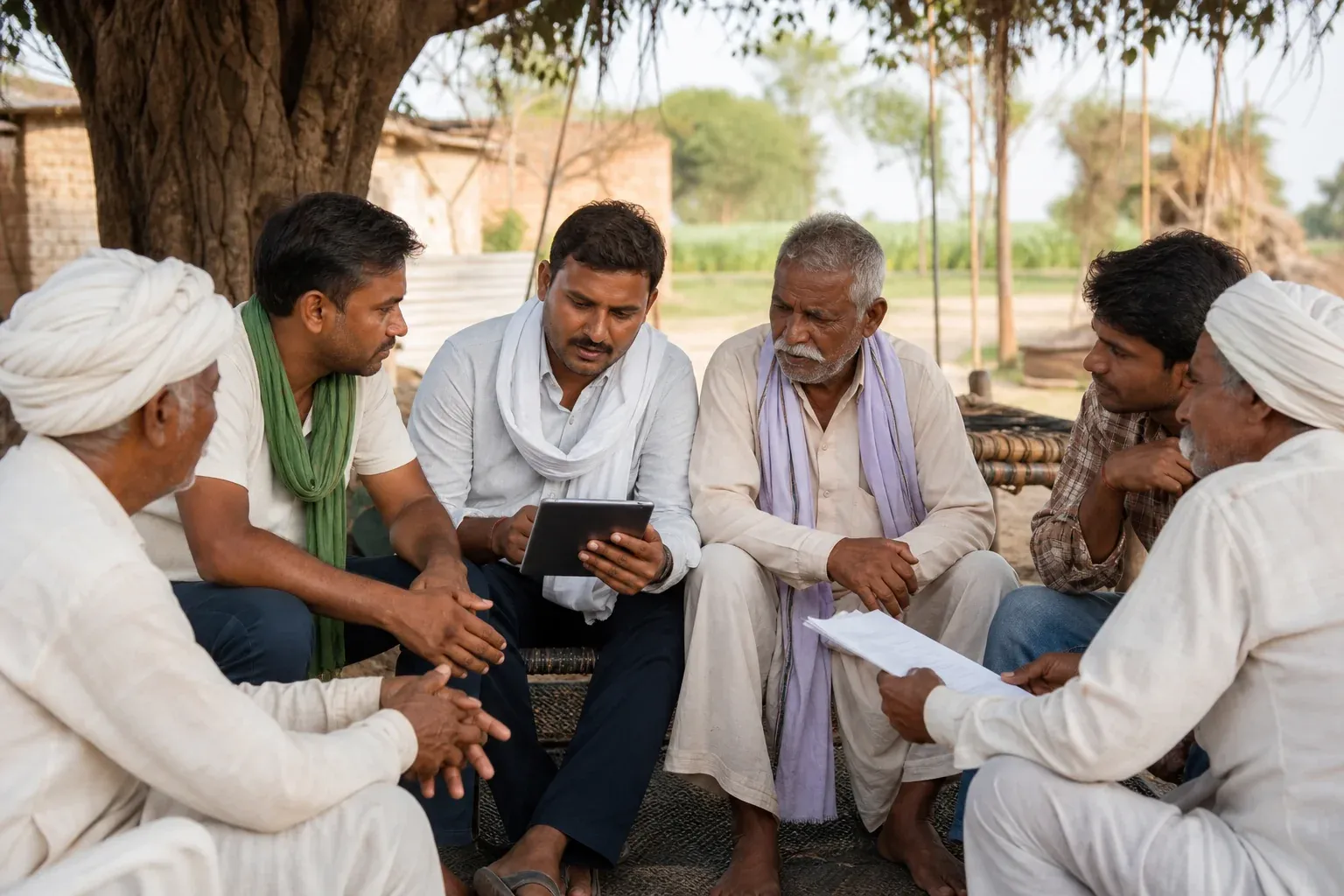
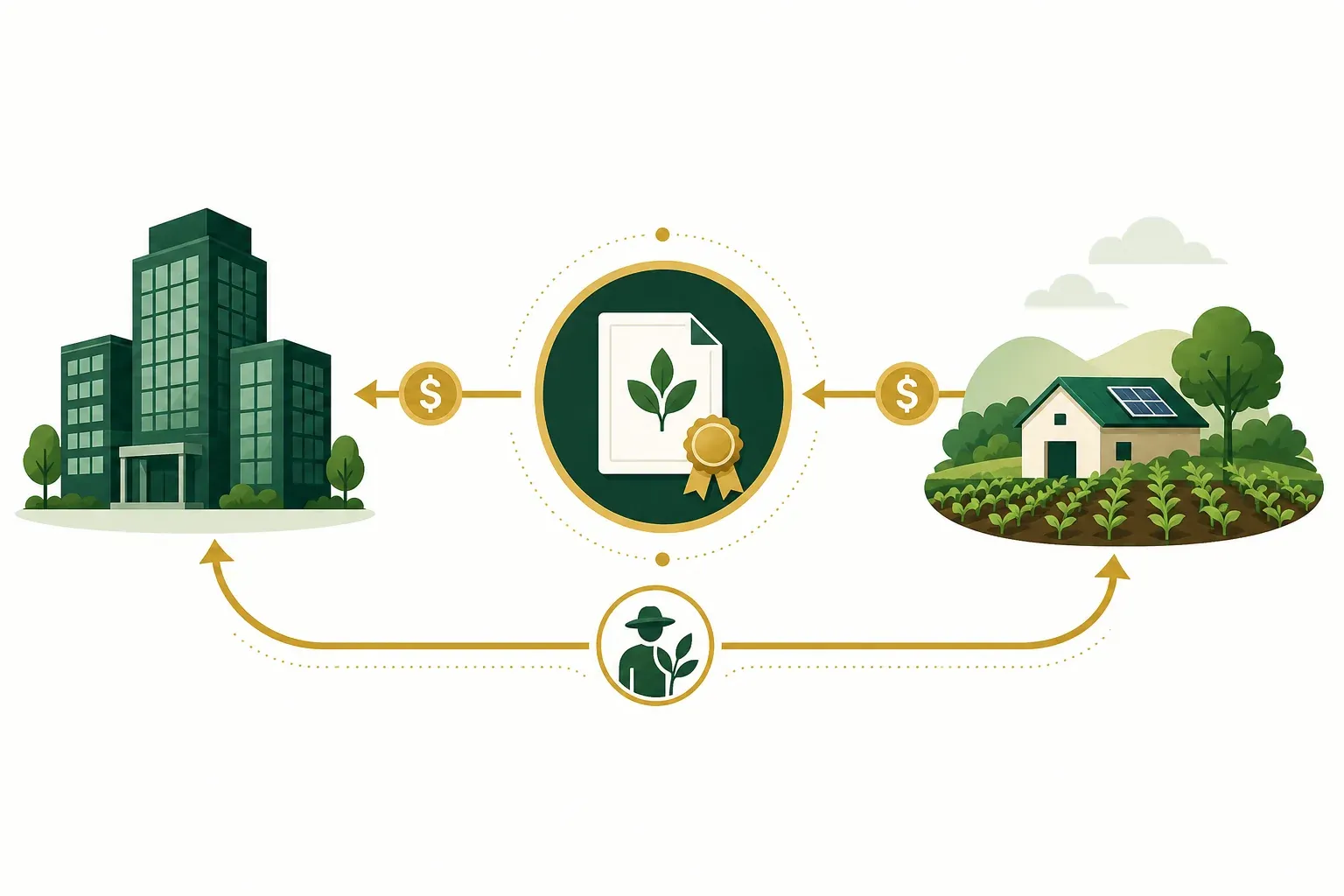
An aggregator, which could be an NGO, a private consultancy, a Farmer Producer Organisation (FPO), or a company like Beetle Regen, enrolls a large number of farmers into a single carbon project. The aggregator handles the technical work: methodology selection, baseline measurement, MRV system setup, verification coordination, and credit sales. Farmers contribute their land and their practice changes. Revenue from credit sales flows back to farmers after the aggregator deducts its costs and fee.
FPOs are particularly well-positioned to serve as aggregation vehicles because they already have legal standing, farmer membership structures, and in many cases existing relationships with input suppliers and buyers. If your village has an active FPO, ask whether it has explored carbon program participation. For a detailed look at how cooperative aggregation maximizes returns, see Carbon Sequestration in Agriculture: A Complete Framework.
What to Look for in an Aggregator
Not all aggregation programs are designed with farmer interests at the center. Before signing anything, ask these questions:
- What percentage of credit revenue goes to farmers, and is this written into the contract?
- Who owns the carbon rights, the farmer or the aggregator?
- Can farmers exit the program if they are dissatisfied, and under what conditions?
- Will farmers receive copies of their soil test results and credit issuance records?
- Is capacity building, training in regenerative practices, included, or is this purely a monitoring exercise?
Red Flags to Watch For
Programs where the aggregator retains 70% or more of credit revenue without providing substantial services (training, input support, market linkages) should raise concern. Contracts with multi-year lock-in clauses that prevent farmers from joining competing programs are another warning sign. A well-designed program treats farmers as partners, not as land assets to be enrolled and monitored.
Beetle Regen's approach to carbon credit monetization is built around farmer-first supply chains, where carbon revenue is one component of a broader value proposition that includes regenerative practice training, soil health improvement, and premium market access for crops like regenerative cotton. This integrated model means farmers benefit from multiple income streams, not just carbon payments.
Step 4: Adopt the Required Practices and Document Everything
Once enrolled in a program, the work begins on the ground. The specific practices required depend on the methodology, but the documentation requirement is universal: if it isn't recorded, it didn't happen as far as a carbon verifier is concerned.
Practices That Generate Carbon Credits
The most common practice changes for Indian smallholders include:
- Reduced or zero tillage: Minimizing soil disturbance preserves existing soil organic matter and reduces carbon release from the soil profile.
- Cover cropping: Growing legumes or grasses between main crop seasons adds organic matter and fixes nitrogen. For a detailed guide, see Cover Crops in Regenerative Agriculture: A Complete Guide.
- Biochar application: Incorporating biochar into soil creates a stable, long-duration carbon sink. Biochar also improves water retention and nutrient availability, a dual benefit for farmers in rain-fed systems. Learn more about the science behind this in Biochar Carbon Removal: Durability, Ratings & Who Should Care.
- Alternate Wetting and Drying (AWD): For rice farmers, controlled irrigation cycles reduce methane emissions from flooded paddies, one of the most cost-effective emission avoidance interventions available to smallholders.
- Agroforestry integration: Planting trees on field boundaries or within crop rows sequesters carbon above and below ground while providing shade, windbreaks, and additional income from timber or fruit.
- Compost and organic matter management: Replacing synthetic fertilizers with compost and crop residue incorporation builds soil organic carbon over time.
Documentation Requirements
Farmers (or their FPO representatives) need to maintain records of: input purchases and applications, tillage operations (or the absence of them), irrigation events (for AWD programs), GPS-mapped field boundaries, and any crop failures or unusual weather events. Many modern programs provide a smartphone-based data entry app that simplifies this process, field agents can help farmers log data during regular farm visits. The key is consistency: gaps in records create gaps in credit claims.
Soil Testing as the Foundation
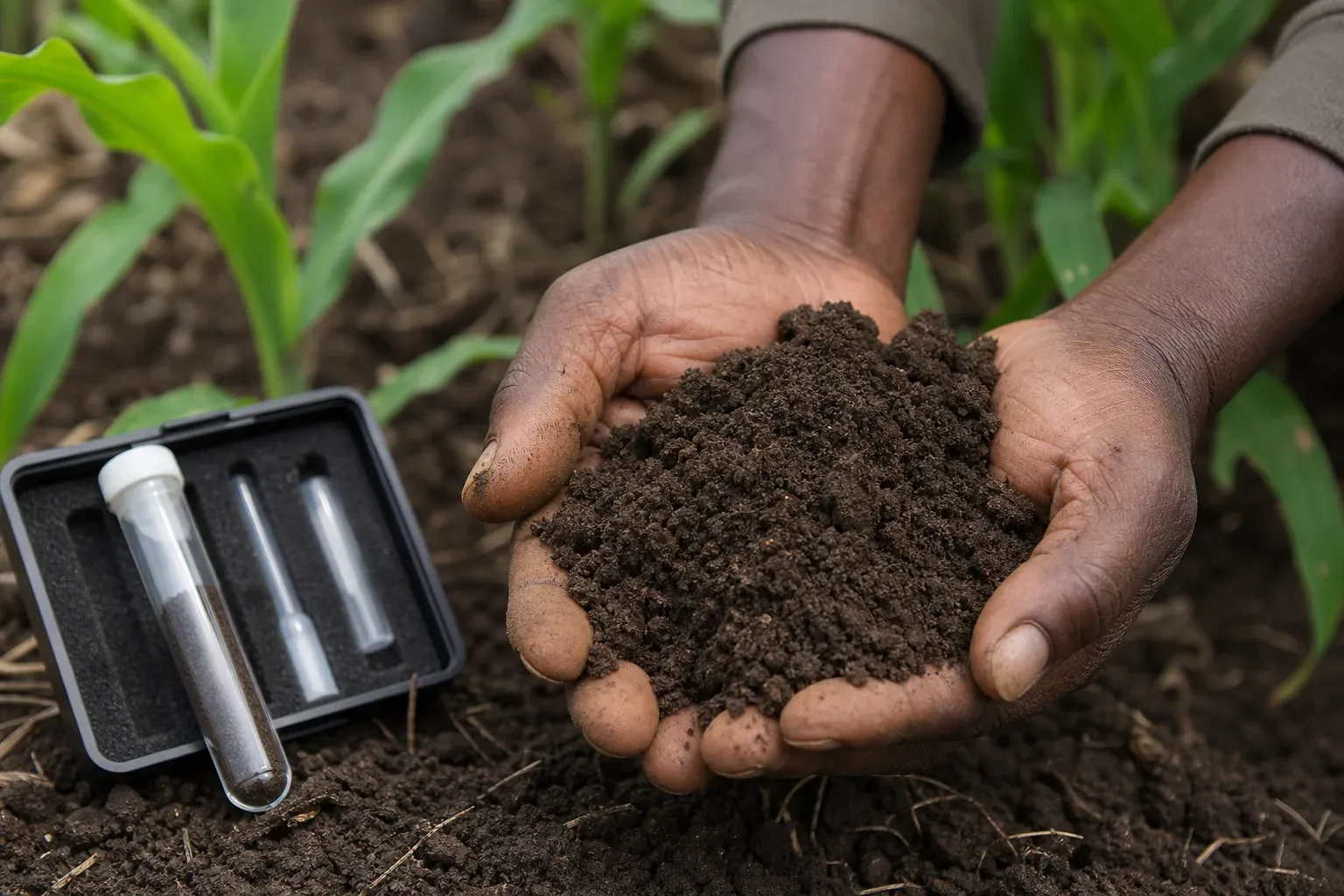
Baseline soil testing, measuring organic carbon percentage, bulk density, and pH before the program starts, is the reference point against which all future measurements are compared. Subsequent soil samples (typically annually or every two years) track the change in soil organic carbon. This is both a scientific requirement and a practical benefit: farmers who see their soil carbon numbers improving have tangible evidence that their practice changes are working. For more on what soil tests reveal and how to interpret them, see Sustainable Farming: A Complete Guide to Regenerative Agriculture.
Step 5: Navigate the Verification and Issuance Process
Verification is the step that converts practice changes and soil measurements into actual carbon credits on a registry. It is also the step that most farmers never see directly, it happens at the project level, managed by the aggregator. But understanding what it involves helps farmers ask the right questions and know what they are entitled to receive.
What Third-Party Verification Involves
A third-party verifier is an independent auditing organization accredited by the relevant registry (Verra, Gold Standard, or India's domestic Bureau of Energy Efficiency framework). The verifier reviews all project documentation, conducts site visits to a sample of enrolled farms, checks soil test data against field records, and confirms that the claimed practice changes actually occurred. This process typically takes three to six months from submission of the monitoring report.
Buffer Pools and Credit Issuance
Once verification is complete, the registry issues credits. However, not all verified credits go directly to sale. A percentage, typically 10 to 20%, is held in a buffer pool, which acts as insurance against future carbon losses (for example, if a drought kills cover crops or a farmer reverts to conventional tillage). Buffer pool credits are not sold; they exist to protect the integrity of the overall project.
The remaining credits are issued to the project account on the registry (Verra's registry, for example, is publicly searchable). Each credit has a unique serial number, a vintage year, and a project identifier. This traceability is what allows corporate buyers to verify that the credits they purchase are real, additional, and not double-counted.
Timeline Expectations
Farmers should plan for an 18 to 36 month timeline from program enrollment to first payout. This reflects the time needed for baseline establishment, the first monitoring period (usually 12 months), verification, and credit sale. Some programs offer advance payments or bridge financing against expected credit issuance, ask your aggregator whether this is available.
Step 6: Understand Payout Structures and Protect Your Share
Carbon credit revenue flows from the buyer (typically a corporate sustainability team or a carbon broker) to the project account, then through the aggregator to individual farmers. The structure of this flow, and the percentage that reaches the farmer, varies enormously between programs.
Revenue Share Models
Two common structures exist:
- Fixed price per tonne: The farmer receives a predetermined amount per tonne of CO₂e credited to their land, regardless of the market price at which credits are sold. This provides certainty but means farmers don't benefit if market prices rise.
- Percentage of sale price: The farmer receives a defined share (for example, 40-60%) of whatever price the credits fetch on the market. This exposes farmers to price volatility but allows them to benefit from premium pricing.
Neither model is inherently better, the right choice depends on the farmer's risk tolerance and the aggregator's transparency. What matters most is that the revenue share percentage is written into the contract before the program begins, not determined unilaterally by the aggregator after credits are sold.
Co-Benefits and Premium Pricing
Credits from smallholder agricultural programs often carry co-benefit premiums, additional value attributed to biodiversity improvements, water quality benefits, and rural livelihood impacts. Buyers, particularly textile brands seeking to meet their Scope 3 targets through carbon insetting, are increasingly willing to pay a premium for credits that come with documented social and environmental co-benefits and a traceable supply chain link. This is where the intersection of regenerative agriculture and carbon markets becomes particularly powerful for Indian smallholders: a farmer growing regenerative cotton and generating soil carbon credits can access two premium income streams simultaneously. For more on how textile brands use these credits, see Carbon Insetting Solutions: Decarbonize Your Textile Supply Chain.
India's Domestic Carbon Market
India's Carbon Credit Trading Scheme (CCTS), administered by the Bureau of Energy Efficiency under the Energy Conservation Act, is in active development as of 2026. While the initial focus has been on industrial sectors, the framework includes provisions for agricultural and forestry projects. Farmers enrolled in programs aligned with recognized international methodologies are well-positioned to access this domestic market as it matures, potentially opening a second sales channel alongside the voluntary market.
What to Demand from Any Carbon Program Partner
The carbon market is not uniformly farmer-friendly. Some programs are designed primarily to generate credits for sale, with farmer welfare as a secondary consideration. Before enrolling, every smallholder, or their FPO representative, should insist on the following non-negotiables.
Transparent Contracts
The contract must specify: the revenue share percentage, the payment timeline, the exit conditions, and who owns the carbon rights. If an aggregator is unwilling to put these terms in writing before enrollment, that is a clear signal to walk away.
Data Access
Farmers should receive copies of their baseline soil test results, annual monitoring data, and credit issuance records. This data belongs to the farmer as much as to the project. Programs that withhold this information from enrolled farmers are not operating in good faith.
Capacity Building, Not Just Monitoring
A carbon program that only monitors what farmers do, without training them in why the practices work and how to optimize them, is extracting value from farmers rather than building it. Genuine capacity building means farmers understand the science behind soil carbon, can troubleshoot practice challenges, and develop skills that persist beyond the program period. This is the model that regenerative agriculture programs with proven yield outcomes are built on.
A Named Grievance Mechanism
If a farmer believes their credit allocation is incorrect, their payment is delayed, or their contract terms have been violated, there must be a clear process for raising and resolving the dispute. This should be documented in the program design, not left to informal negotiation.
Alignment with Recognized Standards
Programs should operate under internationally recognized methodologies (Verra, Gold Standard) or India's domestic CCTS framework. Programs that claim to generate "carbon credits" without registry issuance are not generating tradeable credits, they are generating internal accounting entries that have no market value.
Frequently Asked Questions
How many acres do I need to participate?
Most aggregated programs accept individual plots as small as one acre. The minimum is set at the project level, not the individual farm level. If your FPO or aggregator has enrolled enough total land, your single acre qualifies. Contact a program coordinator to confirm the current enrollment threshold for active programs in your region.
How long before I receive my first payment?
Expect 18 to 36 months from enrollment to first payout. This reflects the monitoring period, verification process, and credit sale timeline. Some programs offer advance payments against expected credits, ask specifically about this when evaluating program partners.
Will joining a carbon program affect my existing subsidies or crop insurance?
In most cases, no. Carbon program participation is separate from government subsidy schemes like PM-KISAN or crop insurance under PMFBY. However, if a program requires you to stop using certain subsidized inputs (like urea), factor that cost into your assessment of net benefit. Always clarify this with your program coordinator before enrolling.
Can I sell credits and also sell regenerative cotton at a premium?
Yes, and this is one of the most compelling aspects of integrated regenerative programs. A farmer who adopts regenerative practices can simultaneously generate carbon credits (from soil carbon improvements) and access premium markets for traceable, regenerative cotton. These two income streams are complementary, not competing. This dual-value model is central to how Beetle Regen structures its farmer programs.
What happens if my crop fails, do I lose my credits?
A crop failure does not automatically invalidate your carbon credits, because soil carbon changes are measured in the soil, not in the standing crop. However, if a failure leads you to revert to conventional practices (heavy tillage, burning residues), that could reduce the carbon benefit measured in subsequent monitoring periods. The buffer pool exists precisely to absorb these kinds of variability events without penalizing individual farmers.
Is there a domestic Indian carbon market I can access?
India's Carbon Credit Trading Scheme (CCTS) is operational for industrial sectors and is expanding. Agricultural projects aligned with recognized methodologies are expected to gain access as the framework matures. Staying enrolled in a well-designed program now positions farmers to access this domestic market when it opens fully, without needing to restart the baseline and monitoring process.
The bottom line: Smallholder farmers in India can access the carbon market, but only through well-structured aggregation programs with transparent contracts, genuine capacity building, and fair revenue sharing. The technical complexity is real, but it belongs to the program partner, not the farmer. Your job is to adopt the practices, maintain the records, and demand fair terms.
Taking the Next Step
The voluntary carbon market will not wait for farmers to figure it out alone. Buyers are actively seeking high-quality, traceable agricultural carbon credits from India, and the programs that enroll farmers now will be the ones issuing credits when demand peaks. The window to establish a strong baseline and enter the market at favorable terms is open today.
If you represent an FPO, a cooperative, or a farming community in India and want to understand whether your land and practices qualify for a carbon program, or if you are a brand or supply chain partner looking to connect carbon insetting with traceable regenerative sourcing, Beetle Regen works directly with farmers and supply chain partners to design programs that deliver real value at the farm level. Reach out to the Beetle Regen team to discuss what a farmer-first carbon program looks like for your specific context, crop system, and geography. The conversation starts with your land, your practices, and your terms, not ours.