How Biochar Boosts Farmer Income in Regenerative Agriculture
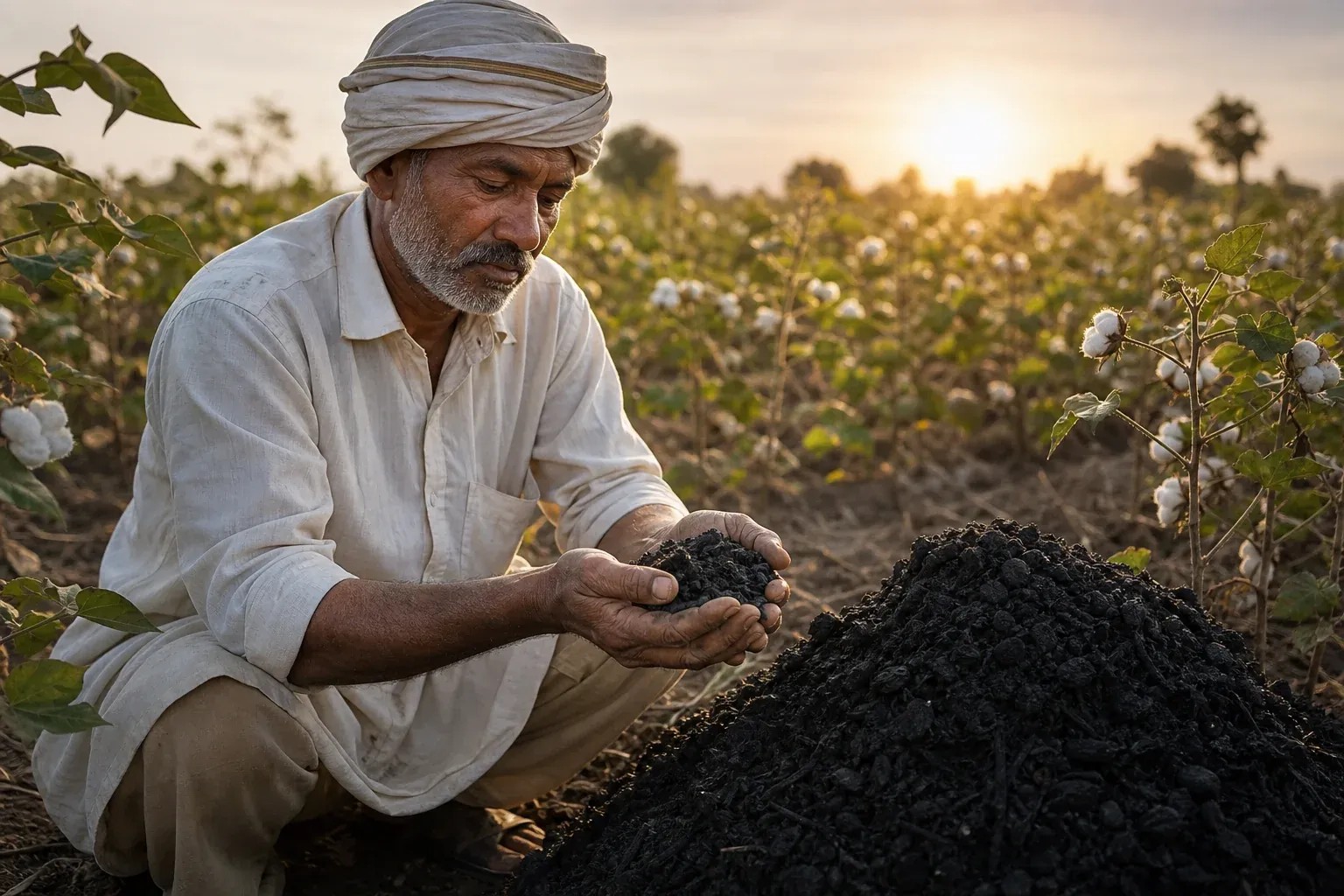
A cotton farmer in Yavatmal district once told a Beetle Regen field coordinator something that cuts to the heart of this issue: "My soil got better two years ago. My bank account did not notice until this year." That gap, between an agronomic improvement and a rupee actually landing in a farmer's hand, is the real problem this article addresses. Improving soil is necessary. It is not sufficient. Farmers need to know, in practical terms, how to use biochar to improve farmer income in regenerative agriculture — not just how to improve their soil carbon score.
Most conversations about biochar stop at soil chemistry: cation exchange capacity, water retention, microbial habitat. Those benefits are real and well documented. But a smallholder farmer with two or three acres does not manage a soil science lab. They manage a household budget. This piece focuses on the financial mechanics, how biochar production and application convert into two distinct, stackable income streams, and what a realistic transition timeline looks like for a farmer moving from conventional to regenerative practice.
The Income Problem Biochar Was Never Meant to Solve Alone
Input costs for fertilizer, diesel, and pesticide have climbed steadily across Indian cotton and cereal belts over the past decade, while output prices for raw cotton and grain fluctuate with global commodity cycles the farmer has no control over. A single bad monsoon or a mid-season pest outbreak can wipe out a season's margin. This is the structural squeeze: rising costs, volatile revenue, and almost no buffer.
Biochar by itself will not fix commodity price volatility. What it does, when embedded inside a broader regenerative system, is attack the cost side of the ledger and open an entirely new, non-yield-dependent revenue line: carbon credit or carbon insetting payments. That combination, lower input spend plus a new income stream unrelated to the harvest, is what actually moves a household's finances. Our complete guide to regenerative agriculture covers the full practice set; this article isolates the income mechanics specifically tied to biochar.
What Biochar Actually Does to a Farmer's Bottom Line
It helps to separate two things that get conflated constantly: biochar's effect on soil, and biochar's effect on a farmer's cash flow. The soil effect is upstream. The income effect is downstream, and it shows up in three places on a farm ledger.
- Reduced fertilizer dependency. Biochar's porous structure holds nutrients in the root zone longer, which means less nitrogen and potash leaches away between applications. Over several seasons, farmers using biochar as part of a regenerative input stack typically apply less synthetic fertilizer to hit the same yield target, directly cutting one of their largest recurring cash outlays.
- Lower irrigation and water-related risk. Because biochar improves water-holding capacity, crops show more resilience during dry spells between rainfall events. That resilience translates into fewer emergency irrigation cycles and, more importantly, fewer catastrophic yield losses in a poor monsoon year.
- A new, harvest-independent revenue line. This is the piece most farmers have never heard of: verified biochar carbon removal can be sold as carbon credits or insetted directly into a textile brand's supply chain, generating payment that has nothing to do with cotton or grain prices that season.
Our related post on how regenerative agriculture increases crop yield goes deeper into the agronomic side. Here, the focus stays on what these changes mean financially.
1. Convert Crop Residue Into Biochar Instead of Burning It
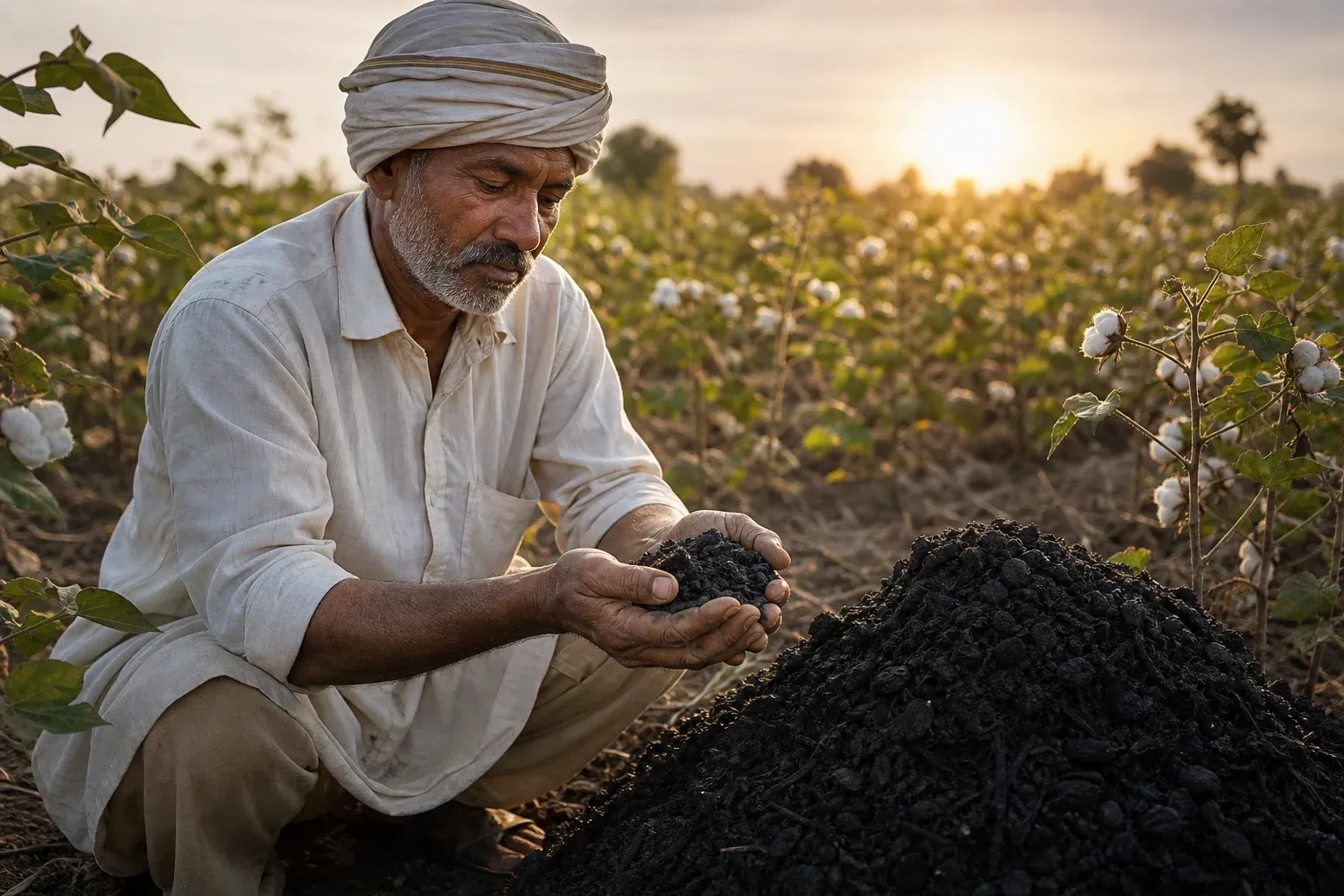
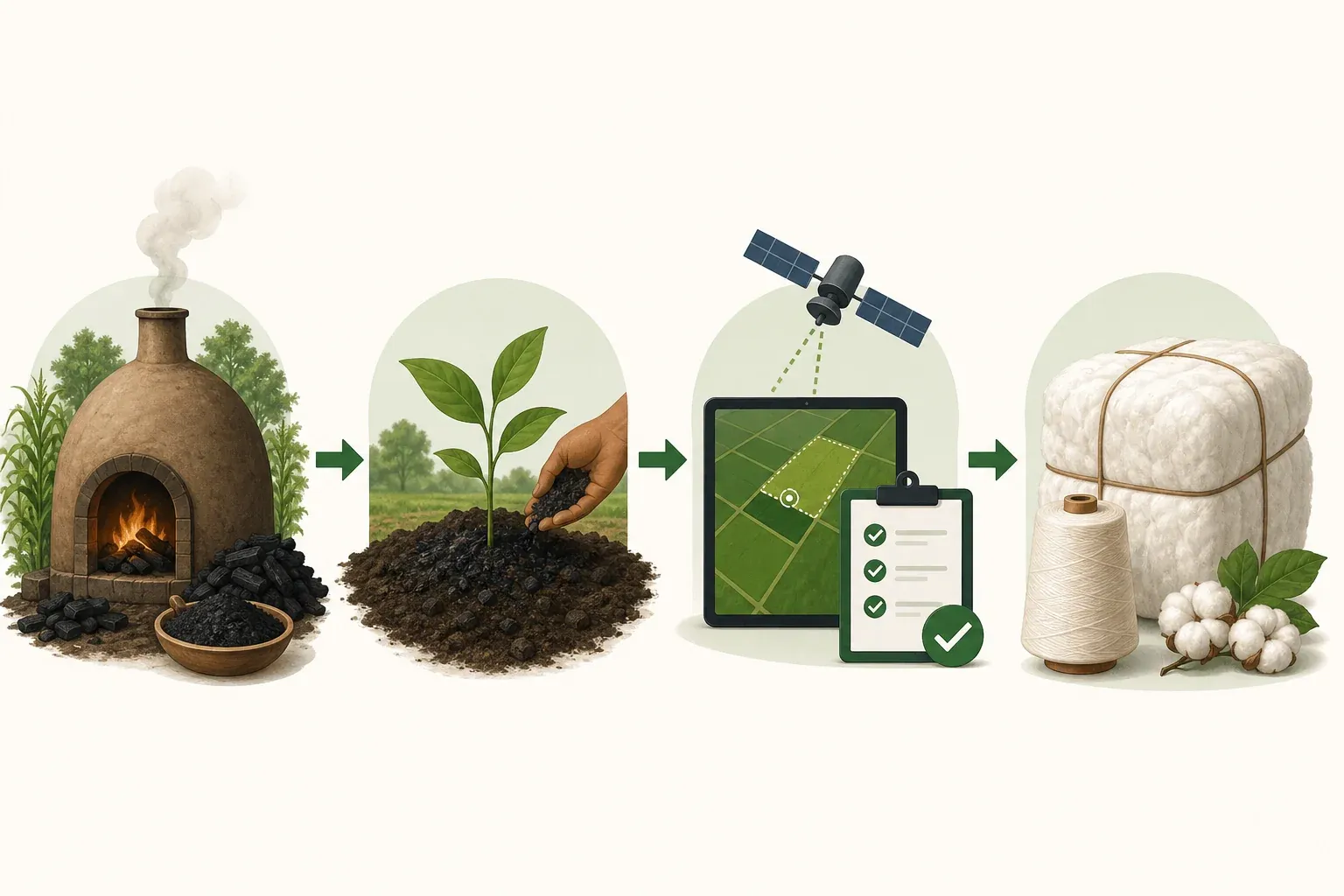
Across Punjab, Haryana, and parts of Madhya Pradesh, farmers burn crop residue every year, mostly because there is no cheaper way to clear a field fast between seasons. That burning wastes a resource that could become income. Cotton stalks, rice husk, and other agricultural residue can be converted into biochar using low-cost pyrolysis kilns, some of which are simple enough to build and operate at the farm or village level with basic training.
Instead of a liability, the residue becomes an asset with two uses: a share stays on the farm as a soil amendment, and a share, once volume builds up across a cooperative, can support a carbon credit program. This single shift, from burning to converting, is often the first practical step in any biochar income model, and it comes with an added public-health and regulatory benefit: it avoids the air-quality penalties and fines increasingly attached to stubble burning in several Indian states.
Beetle Regen's farmer training programs walk cooperatives through kiln selection, safe operation, and residue sourcing logistics, because getting this first conversion step right determines the quality and volume of everything that follows.
2. Apply Biochar as Part of a Regenerative Input Stack
Biochar applied in isolation, without complementary practices, delivers a smaller and slower return than biochar applied as one layer of an integrated system. Farmers who combine biochar with compost, reduced tillage, and cover crops tend to see faster improvements in soil structure and water retention, which shortens the time it takes for input savings to show up.
Timing and placement matter more than volume. Biochar is typically charged with compost or manure before field application, since raw biochar can temporarily tie up soil nutrients if applied alone. Application is usually concentrated in the root zone at planting, rather than broadcast across the whole field, to get the most benefit per kilogram produced. A trained agronomist or field coordinator can help a farmer calibrate rate and placement to their specific soil type and cropping pattern, since a blanket recommendation rarely fits every plot.
This is also where crop selection and rotation planning intersect with biochar economics. Farmers already practicing rotation see the biochar effect compound faster because the soil is already building organic matter through diverse root systems and residue inputs.
3. Enroll in a Carbon Insetting or Carbon Credit Program
This is the step that turns biochar from a soil input into an income product. When biochar is produced and applied under a monitored, verified protocol, the carbon it locks into the soil, often for centuries, can be quantified and sold as a carbon credit, or "insetted" directly into a textile brand's own supply chain to offset its Scope 3 emissions.
The distinction between these two paths matters for a farmer's income model:
- Carbon insetting means a specific brand, say a cotton buyer supplying H&M or Primark, pays for the carbon benefit generated within its own sourcing region, and can claim that reduction against its own supply chain emissions. Payment is often structured as part of a broader regenerative cotton program with a cooperative.
- Open-market carbon credits are sold through a registry (such as Verra or Gold Standard protocols for biochar) to any buyer globally seeking verified carbon removal, independent of any specific supply chain relationship.
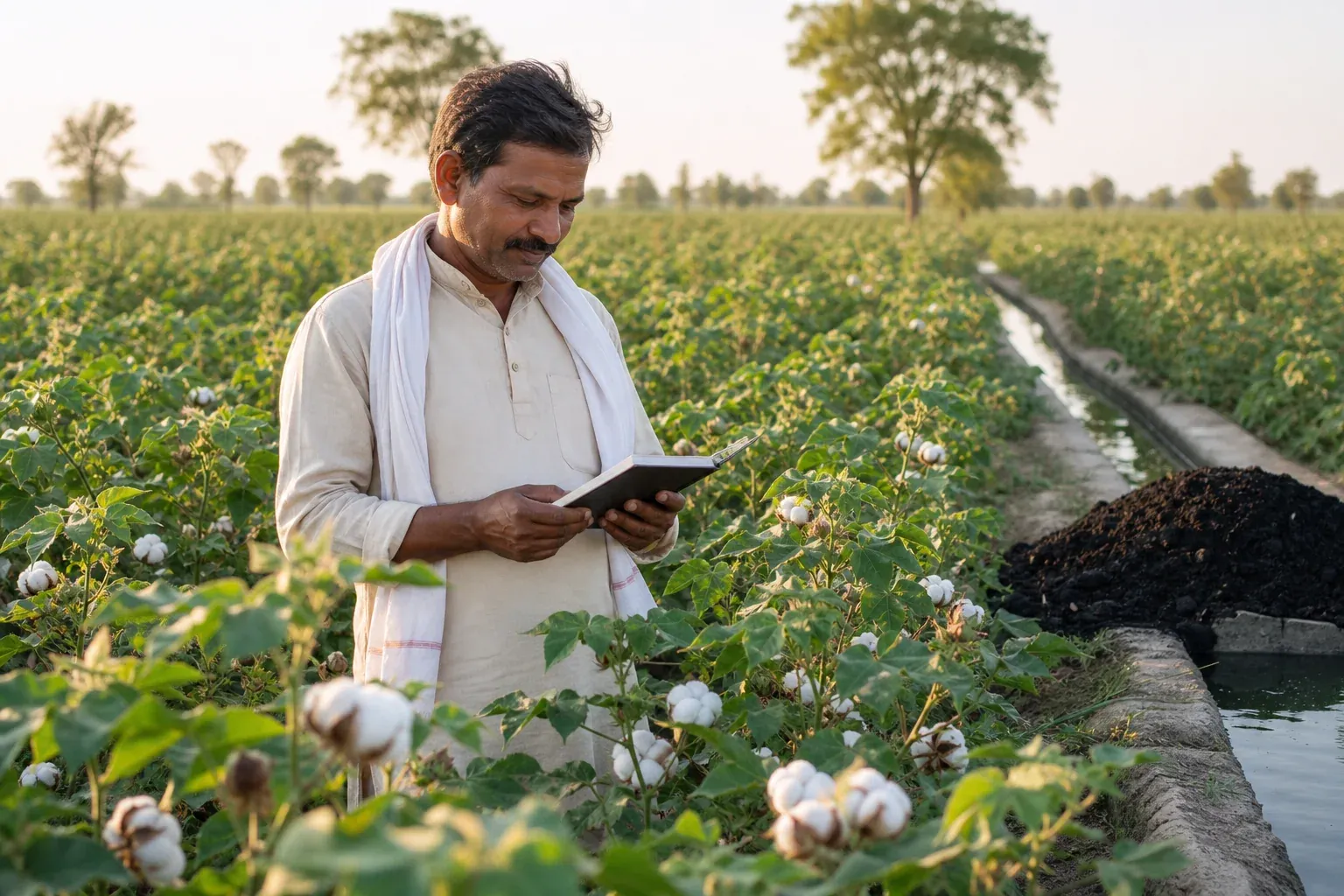
Both paths require rigorous measurement, reporting, and verification (MRV) to confirm how much biochar was produced, applied, and how much carbon it actually sequestered. Our detailed breakdown of MRV and traceability systems for cotton explains what this data collection looks like on the ground. Without solid MRV, credits cannot be issued and payment cannot be triggered, which is why farmer-level record keeping, even something as simple as photographing kiln batches and field application dates, becomes part of the income process, not an afterthought.
For a closer look at how durable biochar-based carbon removal actually is compared to other credit types, see our piece on biochar carbon removal durability and ratings.
4. Aggregate Through Farmer Cooperatives to Increase Bargaining Power
A single farmer with two acres of biochar-treated land does not generate enough carbon volume to interest most credit buyers, and the cost of independently verifying that small volume would eat most of the payment. This is why aggregation through a cooperative or farmer producer organization is central to making biochar income actually work at the smallholder scale.
When dozens or hundreds of farmers in a district pool their biochar production and application data under one verification umbrella, three things happen. Verification costs get spread across a much larger volume, which improves the per-farmer payout. The combined credit volume becomes large enough to interest institutional buyers and textile brands. And the cooperative gains negotiating leverage that an individual farmer never has alone.
This aggregation model mirrors the collective approach already working in India's regenerative cotton sector, where cooperative-level data pooling has driven better outcomes for smallholders than individual contracts ever could.
A Realistic Two-Season Income Scenario
To make this concrete, here is an illustrative scenario built from typical patterns seen across transitioning smallholder cotton farms, not a specific individual's audited results, but a realistic composite showing how the pieces fit together.
In season one, a farmer transitions roughly half of their cotton acreage to a regenerative input stack that includes farm-produced biochar, compost, and reduced tillage. Fertilizer spend on that portion of the land drops modestly as biochar improves nutrient retention, and the crop shows better resilience during a mid-season dry spell that historically would have forced an emergency irrigation cycle. Yield on the treated plot holds steady or improves slightly, while input costs fall. The net effect that first season is a modest but real improvement in margin, driven almost entirely by cost savings rather than yield jumps.
By season two, with biochar production scaled across the cooperative and enough application data verified through the program's MRV process, the farmer's plot qualifies for its first carbon credit or insetting payment. This payment arrives independently of the harvest outcome that season, meaning even a weaker monsoon year still delivers a positive cash inflow the farmer would not have had under conventional practice. Combined, the input savings and the carbon payment produce a meaningfully improved household income position compared to the pre-transition baseline, with the carbon revenue acting as a buffer against the yield volatility that defines conventional farming.
This pattern, savings first, carbon revenue compounding in afterward, is consistent with what we've documented in more depth in our post on regenerative agriculture's yield impact, and it is the model Beetle Regen structures its farmer training programs around: get the cost savings established early, then layer in verified carbon income once production and application data reach program thresholds.
How Textile Brands Benefit From Funding Farmer Biochar Programs
None of this scales without demand-side capital, and that is where textile and fashion brands enter the picture. Brands sourcing cotton from India, including suppliers feeding into companies like H&M, Primark, and other major retailers, face growing pressure to demonstrate real Scope 3 emissions reductions, not just offset purchases disconnected from their actual supply chain.
Funding farmer-level biochar programs gives these brands something offsets alone cannot: a traceable, farm-to-fashion story where the carbon reduction happened inside their own cotton sourcing region, among the farmers actually growing their fiber. That traceability is increasingly not optional. The EU Corporate Sustainability Reporting Directive (CSRD) is pushing textile manufacturers, including many based in India, toward far more granular supply chain emissions disclosure, and biochar-based carbon insetting programs with verified farmer data are one of the few credible ways to meet that bar.
Our guide on carbon insetting solutions for textile supply chains walks through how brands structure these programs, and our fashion brand net zero roadmap covers the compliance milestones brands need to hit along the way. From the farmer's side, this brand demand is what actually funds the biochar kilns, the training, and the MRV infrastructure that makes the income model work in the first place.
For brands evaluating how regenerative cotton pricing compares to conventional sourcing once these programs are factored in, our breakdown of regenerative versus conventional cotton costs is a useful next read.
Common Challenges Farmers and Brands Face When Scaling Biochar Income Models
This model works, but it is not friction-free. Being direct about the obstacles is more useful than pretending they do not exist.
- Upfront kiln and training investment. Even low-cost pyrolysis kilns require capital and technical training that individual smallholders rarely have on hand, which is why cooperative or program-level financing, rather than farmer self-funding, is usually the workable path.
- MRV complexity and cost. Verifying biochar's carbon benefit requires consistent data on feedstock, kiln temperature, application rate, and soil outcomes. Without a structured system, this data collection is a genuine burden, which is why our guide to integrating regenerative agriculture data across supply chains focuses so heavily on getting this infrastructure right from day one.
- Carbon price volatility. Credit prices in voluntary carbon markets fluctuate, and insetting arrangements tied to a specific brand relationship carry counterparty risk if that brand's sourcing priorities shift. Diversifying between insetting contracts and open-market credit sales can reduce this exposure.
- Knowledge gaps at the farm level. Many farmers have simply never been trained on regenerative practice sequencing, biochar application rates, or how carbon markets function. Structured, ongoing capacity building, not a single workshop, is what closes this gap over multiple seasons.
Consultancies working directly with farmer cooperatives can absorb much of this complexity on the farmer's behalf, negotiating credit buyers, managing MRV systems, and structuring training so farmers can focus on production rather than carbon market mechanics.
Frequently Asked Questions
How much can a farmer earn from biochar carbon credits?
Earnings depend on the volume of verified carbon sequestered, prevailing credit prices, and whether the farmer sells through an open-market registry or a direct brand insetting arrangement. Because these figures shift with market conditions and program structure, farmers should get a specific projection from their program coordinator rather than relying on generic figures. What is consistent is that carbon revenue functions as an additional income layer on top of, not instead of, crop revenue.
Is biochar production expensive for smallholder farmers?
Basic pyrolysis kilns are relatively low-cost compared to most farm equipment, but the investment is rarely something an individual smallholder should shoulder alone. Cooperative-level financing or program support, where a consultancy or brand partner helps fund kiln access and training, is the more common and more sustainable path for smallholders with a few acres.
How long before biochar improves farm income?
Input cost savings from biochar and complementary regenerative practices typically begin showing up within the first one to two seasons. Carbon credit or insetting payments generally take longer, often two to three seasons, because MRV verification requires consistent data across a growing cycle or more before credits can be issued and sold.
Can biochar income work alongside existing regenerative cotton certification?
Yes. Biochar-based carbon programs and regenerative cotton certification are complementary, not competing, systems. Farmers already enrolled in a regenerative cotton program, as described in our overview of what regenerative cotton actually is, can typically layer biochar carbon monetization on top of their existing certification without conflict, since both rely on similar soil health and traceability data.
Start Building a Biochar Income Model That Works for Your Farmers or Your Supply Chain
Biochar's real value in regenerative agriculture is not the soil chemistry alone. It is the combination of lower input costs and a new, verifiable carbon revenue stream that gives smallholder farmers a financial buffer they have never had before. For textile brands, funding this model at the farm level is how a Scope 3 reduction target turns into a traceable, defensible, farmer-first supply chain story rather than a disconnected offset purchase.
Whether you are a farmer cooperative exploring biochar production for the first time, or a brand sourcing cotton from India and Bangladesh that needs a credible carbon insetting partner, Beetle Regen structures these programs from kiln to credit. Contact us to discuss how a biochar-based regenerative program could work for your farming community or your supply chain.